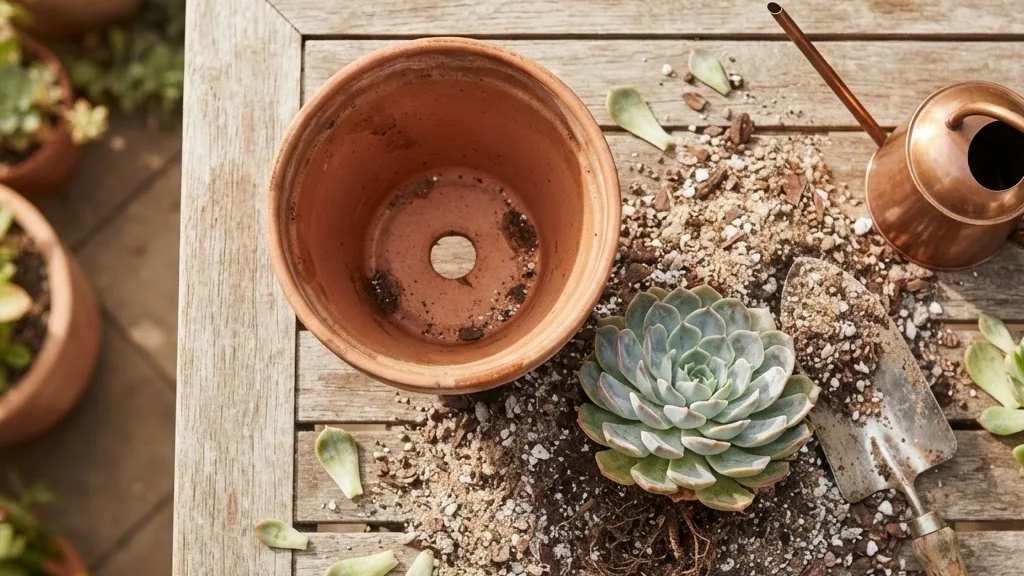
Succulent plants in a pot die from kindness far more often than from neglect, and the single culprit behind most losses is overwatering. Illinois Extension, the outreach arm of the University of Illinois, names it plainly: indoors, these plants generally want water only every two to three weeks, and the most frequent mistake growers make is giving them more. The plant that looks thirsty is usually drowning. That inversion of instinct explains why so many windowsill collections rot from the roots up within a season, and why the fix starts long before you ever pick up a watering can.
It starts with the pot, the soil, and where the light lands. Get those three variables right and a succulent will tolerate almost any watering mistake you make later. Get them wrong and no watering schedule, however careful, will save the plant. This guide works through each variable with the exact figures published by horticultural institutions, then covers repotting, feeding, propagation, and the symptom-by-symptom troubleshooting that most consumer articles skip entirely.
Quick answer: Grow succulent plants in a pot with a drainage hole, using a gritty mix of roughly one-third organic matter and two-thirds mineral grit. Water deeply until it runs out the bottom, then let the soil dry completely, which indoors means roughly every two to three weeks. Give at least six hours of bright light near a south or west window, keep temperatures between 55 and 75 °F, and never let the saucer stay full. Overwatering, not underwatering, kills the most plants.
Why a Drainage Hole Beats Every Fancy Pot You Own
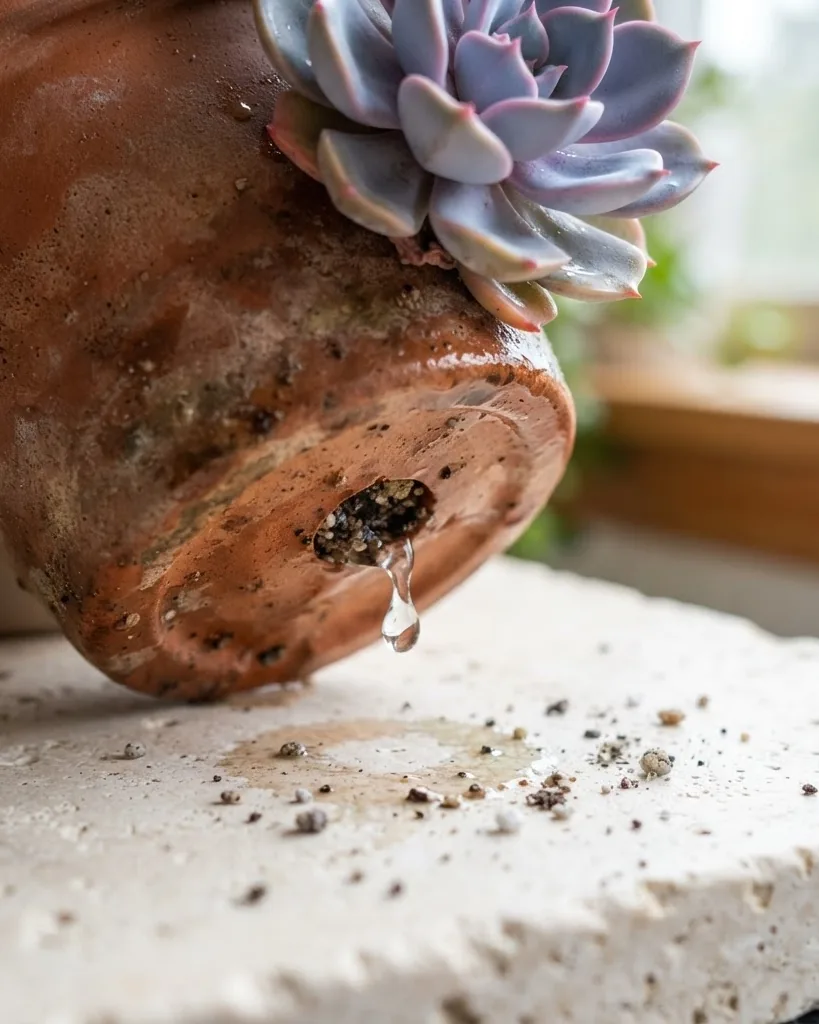
A drainage hole is the non-negotiable feature of any container holding succulents, and it outranks material, color, and price. West Virginia University Extension states the working principle in one line: water the plant until liquid runs out the drainage holes, then wait until the substrate is fully dry before watering again. Without a hole, that flush is impossible, and standing water sits against roots until they rot. A gorgeous glazed cachepot with a sealed base is a coffin with good taste. The physics do not care how the pot looks on the shelf.
Material matters second, and it changes how fast the soil dries.
- Terracotta is porous. It wicks moisture out through its walls, so soil dries faster and roots breathe. This forgives the overwaterer.
- Plastic and glazed ceramic hold moisture longer. They suit dry climates and forgetful waterers but punish anyone with a heavy hand.
- Unglazed concrete or hypertufa behaves similarly to terracotta, wicking moisture through its walls, though it weighs far more and suits outdoor troughs better than a windowsill.
Size is the quiet killer. A pot much larger than the root ball holds a reservoir of wet soil the roots cannot reach or drink, and that dead zone of moisture breeds rot. Choose a container barely bigger than the current one, ideally no more than an inch or two wider in diameter. If you inherit a hole-free decorative pot, add a layer of clay pebbles or broken crockery at the base and never let the inner reservoir fill.
A practical test for anyone unsure whether a container will work: fill it with water and time how long it takes to fully drain when tipped. A pot that holds visible puddled water for more than a few seconds after tipping is telling you it will hold water against roots too. The same drainage logic governs any container plant, and it echoes the fundamentals covered in this guide to growing house plants successfully.
The Soil Mix That Stops Root Rot Before It Starts
Succulent soil succeeds by draining fast and holding little, the opposite of what most bagged potting mixes do. The target blend is roughly one-third organic matter and two-thirds mineral grit, and the Jardin botanique de Montreal, part of the Espace pour la vie institution, gives a precise homemade recipe: one-third coarse sand, one-third perlite, and one-third well-decomposed organic compost. That ratio drains within seconds of watering, denying rot the standing moisture it needs while still feeding the plant a modest organic base.
Standard houseplant compost fails these plants because it is engineered to retain water for thirsty foliage. Succulents evolved somewhere drier. Algoflash traces their origins to the Mexican plateaus and the semi-desert regions of southern Africa, environments where rain arrives hard, drains away, and does not return for weeks. Your pot should recreate that rhythm of flood and drought, not a permanently damp sponge.
Practical building blocks for the mineral two-thirds include:
- Coarse sand for weight and sharp drainage, never fine playbox sand, which compacts into concrete.
- Perlite or pumice for air pockets that keep roots oxygenated.
- A commercial cactus mix if you would rather skip mixing, ideally amended with extra grit.
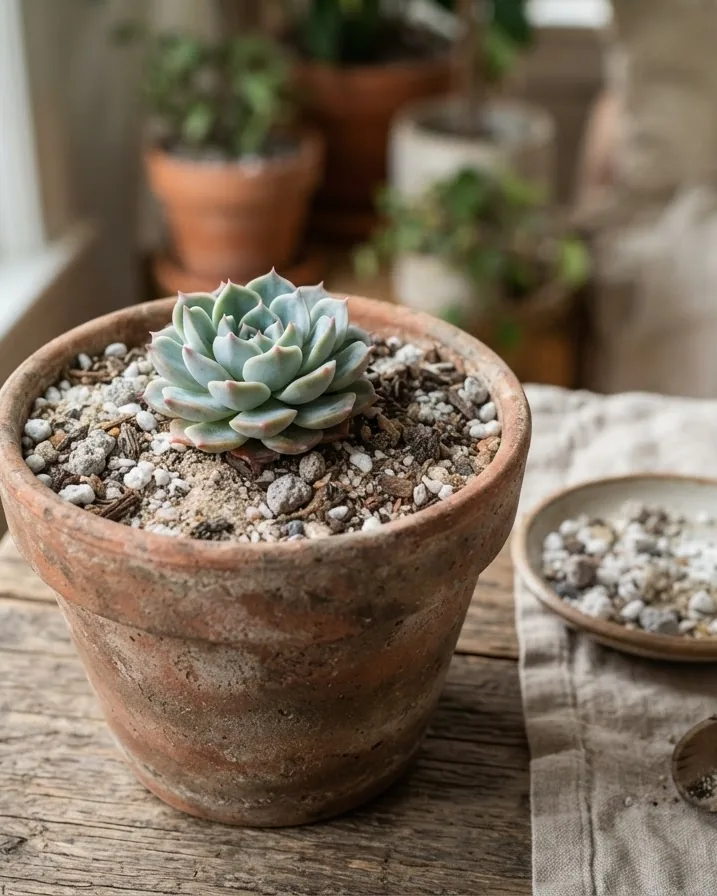
- Fine gravel or crushed granite as a top dressing, which keeps the crown of the plant lifted off damp soil and looks tidy besides.
A quick way to judge any mix before committing a plant to it: squeeze a handful lightly. If it holds a tight ball the way garden loam does, it is too rich and will stay wet too long. If it barely holds together and falls apart the moment you open your hand, the ratio is right for succulents. If you plan to expand a collection through cuttings later, the same free-draining medium works for rooting new plants, a process laid out in this beginner’s guide to propagating plants.
How Often to Water: Real Numbers by Season
Water succulent plants in a pot deeply and infrequently, soaking until liquid drains from the base, then withholding entirely until the soil is bone dry. Illinois Extension puts the indoor interval at roughly every two to three weeks, but that figure shifts with season, heat, and light. Summer growth demands more; winter dormancy demands almost none. The single most useful diagnostic is your finger. Push it two knuckles into the mix, and if you feel any moisture at all, wait longer.
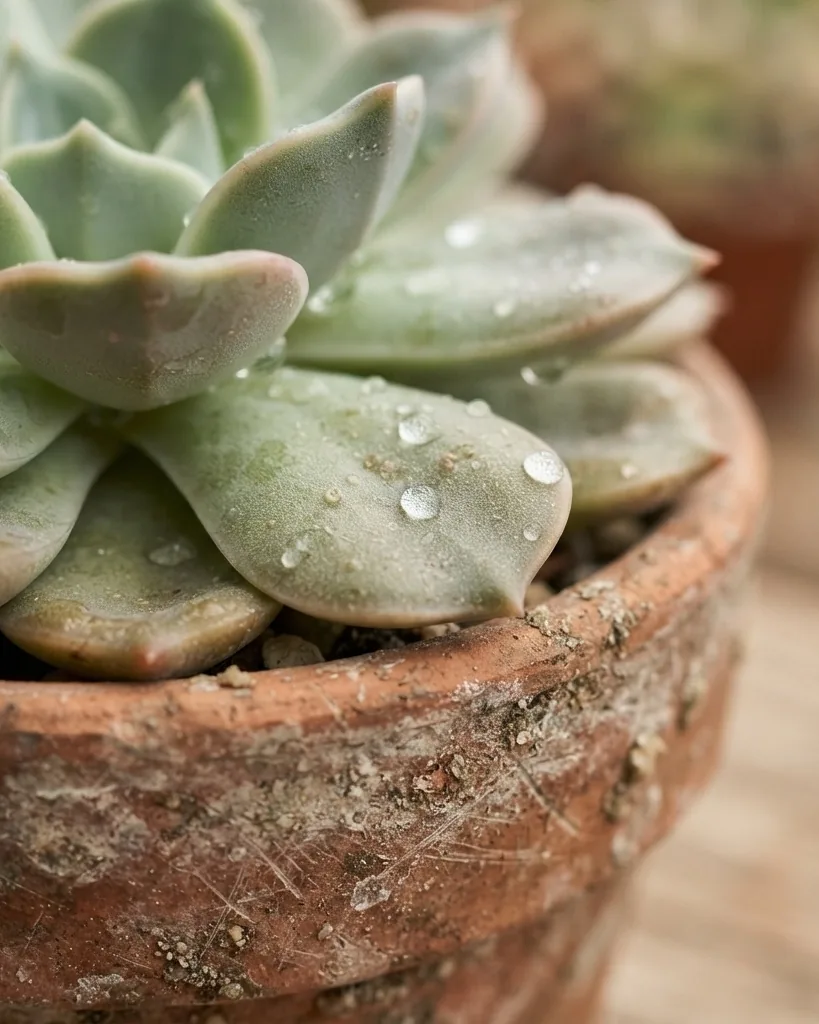
The bassinage, or bottom-watering, method suits rosette species like Echeveria. You set the pot in a shallow tray of water, let the soil draw moisture up through the drainage hole for roughly 3 min, then remove and drain it. This keeps water out of the crown, where trapped droplets rot the growing center. Never wet the heart of a rosette from above.
Species-specific specialist guidance sharpens the seasonal picture further: in a heated indoor setting, expect roughly one watering per month through winter and around two per month through summer, adjusted by how quickly the specific mix you chose actually dries. A gritty, terracotta-housed plant near a warm window will dry faster than the same species in plastic on a cool sill, so treat any fixed schedule as a starting point to check with your finger, not a fixed rule to follow blindly.
A few rules that separate healthy plants from mush:
- Empty the saucer within minutes of watering. Standing water reverses everything the drainage hole achieved.
- Cut back sharply in winter, when cool temperatures and low light slow the plant toward dormancy.
- Water in the morning where possible, so any splashed foliage dries during the day rather than sitting damp overnight.
- When in doubt, do nothing. A shriveled leaf recovers in a day of watering; a rotted stem does not recover at all.
Overwatering is the diagnosis to fear first, but it announces itself before the plant is beyond saving if you know what to look for: leaves that feel soft and slightly translucent rather than firm, a faint sour smell at soil level, or a stem base that darkens. Catching that stage early and simply withholding water, or unpotting to dry the roots faster, often reverses the damage. Fungus gnats hovering over the soil are another early warning that your mix stays too wet, a problem tackled in this walkthrough on getting rid of fungus gnats on houseplants.
Light and Temperature: The Two Numbers That Decide Everything
Light and temperature set the ceiling on how well succulent plants in a pot will grow, and both come with hard figures. West Virginia University Extension advises a window that receives at least six hours of light. Montana State University Extension refines this by species: low-demand succulents cope with two to three hours per day, while high-demand types want a full six hours. For temperature, Iowa State University Extension gives a preferred band of 55 to 75 °F, or roughly 13 to 24 °C, with nights cooler than days. Miss the light and the plant stretches; miss the drainage and it rots.
Etiolation is the visible tax on too little light. The plant stretches toward the window, spacing its leaves along a pale, weak stem in a desperate reach for photons. Once stretched, a stem never recompresses; you can only behead it and re-root the top. University of Minnesota Extension points to a south or west window as the ideal indoor position, and rotating the pot a quarter turn each week keeps growth even instead of leaning toward the glass.
If no window offers six hours of direct or bright indirect light, a simple grow light closes the gap without any guesswork. A basic LED grow light run for twelve to fourteen hours a day, positioned six to twelve inches above the rosettes, substitutes reasonably well for weak winter sun in northern latitudes. It will not perfectly replicate outdoor intensity, but it stops the stretching that a dim corner guarantees.
Sun acclimation matters when moving plants outdoors for summer. A succulent grown behind glass has no defense against direct rays and will scorch, developing bleached or brown sunburn patches within hours. Introduce it gradually, an hour of morning sun the first days, building over a week or two, and always favor morning light over harsh afternoon sun during the adjustment period. On the humidity side, Montana State University Extension notes these plants prefer low relative humidity, in the 10 to 30 % range, which is exactly why dry indoor winter air suits them and bathrooms do not.
Indoors, Outdoors, or Balcony: Matching the Setting to the Plant
Most succulents sold as houseplants tolerate a summer outdoors and thrive for it, provided the move happens gradually and the container still drains. A balcony or terrace in full sun through the warm months often produces tighter, more colorful rosettes than the same plant would ever achieve behind glass, because natural light intensity far exceeds anything a window filters through. The tradeoff is exposure to rain; a container sitting in a saucer that collects days of rainwater will rot roots just as reliably as an overzealous indoor waterer.
Bring plants back indoors before nighttime temperatures threaten to dip below the comfortable range, specifically once nights approach 15 °C, the threshold Algoflash flags for bringing potted succulents back inside, and check the specific cold tolerance of any hardier outdoor succulents like certain Sedum or Sempervivum before assuming they need shelter at all, since some tolerate light frost. Truffaut notes that hardier types such as agave suit a Mediterranean-style garden bed outright, while the softer rosette succulents common indoors have no such tolerance and need protection well before frost arrives.
A practical seasonal routine for anyone moving pots between settings:
- Late spring: begin the gradual sun acclimation described above once nights stay reliably above the mid-fifties Fahrenheit.
- Summer: water more frequently than the indoor two-to-three-week rule, since heat and wind dry an outdoor pot faster, but still let the mix dry between waterings.
- Early autumn: bring plants in before the first cool nights, well ahead of any frost warning.
- Winter: resume the slower indoor watering rhythm and stop feeding entirely.
Feeding Schedule: Less Fertilizer Than You Think
Feed succulents sparingly, because these are plants adapted to lean soils where nutrients arrive rarely. University of Minnesota Extension recommends fertilizing once or twice a month during spring and summer, the active growing season, and giving nothing at all in winter. Overfeeding produces soft, sappy growth that flops and invites pests, the opposite of the compact, sun-hardened form you want. A light hand here does more good than a generous one.
Timing tracks the growth cycle. Spring wakes the plant, summer drives its push, and both windows reward a diluted, balanced feed, typically mixed at half the strength printed on the label. Once cooler nights and shorter days signal dormancy, stop. A dormant plant cannot use the nutrients, and the excess simply accumulates as salts in the soil, burning root tips over time. If you flush the pot occasionally with a plain deep watering, letting several times the pot’s volume run through and out the drainage hole, you clear that buildup before it damages roots.
Keep the feeding logic simple:
- Spring and summer: one to two light feeds per month, matched to visible new growth.
- Autumn and winter: nothing, letting the plant rest.
- After repotting: hold off, since fresh mix already carries a nutrient base.
- Signs of overfeeding: unusually soft, elongated new growth or a white crust forming on the soil surface, both of which call for a flushing watering rather than more fertilizer.
Repotting Rhythm and the Wait Before Watering
Repot succulent plants in a pot every two to three years, or sooner if roots crowd the container, and always into a pot barely larger than the last. The Jardin botanique de Montreal, under Espace pour la vie, sets this interval at two to three years, or as needed when root density climbs, and stresses the barely-bigger rule. Algoflash gives a wider window of two to five years depending on the species and its vigor. Spring is the season to do it, as the plant enters active growth and can heal disturbed roots quickly.
The counterintuitive step is the wait afterward. Do not water immediately. Repotting inevitably tears fine roots, and a fresh wound sitting in wet soil is an open invitation to rot. Give the plant several days to a week of dry rest so those torn roots callus over, then resume normal watering. This single pause prevents a large share of post-repotting deaths, and it is the step most beginners skip because it feels wrong to leave a freshly potted plant dry.
When you slide the plant free, shake off the old mix, inspect the roots, and trim anything blackened or mushy with clean tools, wiping the blade with alcohol between cuts if you are working on more than one plant to avoid spreading rot. Set the plant at the same depth it grew before, backfill with dry gritty mix, and firm it gently without compacting the soil hard. Terracotta shines here again, its porous walls speeding the drying the newly disturbed roots need.
Signs a plant is overdue for repotting include roots visibly circling the drainage hole, water running straight through without any darkening of the soil surface, or the pot tipping easily because roots have displaced most of the growing medium. Fresh-potted succulents pair well with other low-fuss greenery, and beginners building a first collection can start with the options in this easy care guide to the best houseplants for beginners.
Propagation: Leaves, Stem Cuttings, and Offsets
Succulents multiply readily, and the method depends on the species and what growth the parent plant offers. Leaf propagation works well for rosette types like Echeveria: twist a healthy leaf gently from the stem so it detaches cleanly at the base, then set it aside on a dry surface for two to three days until the wound callouses over. Never plant a fresh, uncallused cut directly into moist soil, since an open wound in damp mix is an invitation to rot rather than root.
Once callused, lay the leaf on top of dry, gritty mix without burying it, and mist lightly every few days. Roots and a tiny new rosette will emerge from the base over several weeks, at which point the original leaf shrivels and can be removed. Stem cuttings follow the same callusing logic on a larger scale: cut a healthy section of stem, let the cut end dry and callus for several days to a week depending on thickness, then plant the callused end shallowly in dry mix and withhold water for another week before the first light watering.
Offsets, sometimes called pups, are the easiest route of all for species like Haworthia, Aloe, and many Sedum, since the parent plant produces small genetically identical rosettes at its base with roots already partly formed. Separate an offset with a clean cut or gentle twist, let the cut callus for a day or two, and pot it directly into gritty mix. Because it already carries roots, an offset establishes faster than a leaf or stem cutting and tolerates a slightly earlier first watering.
Diagnosing Sick Succulents: Symptom, Cause, Correction
Most succulent problems announce themselves through the leaves and stem, and reading them correctly turns panic into a fixable checklist. A mushy, translucent, yellowing base means root rot from too much water, and the correction is to unpot the plant, cut away all soft tissue, let the healthy remainder callus, and replant in dry gritty mix. A stretched, pale stem with widely spaced leaves means etiolation from too little light, corrected by beheading and re-rooting the top in a brighter spot. Bleached or brown patches mean sunburn from abrupt sun exposure, corrected by shade and slower acclimation.
Pests are fewer than on most houseplants but not absent. The mealybug is the classic offender, a white cottony insect that clusters in leaf axils and the crevices of rosettes. The field remedy is a cotton swab dipped in alcohol, dabbed directly onto each insect, which dissolves their waxy coat and kills them on contact. Repeat every few days until they stop reappearing, and quarantine the plant from neighbors meanwhile, since mealybugs travel between adjacent pots surprisingly fast.
Two less common but still telling symptoms round out the diagnostic picture. Wrinkled, deflated leaves on a plant that has not been watered in weeks usually mean simple underwatering rather than anything more serious, and a deep soak corrects it within a day. Corky, rough brown scarring on otherwise healthy leaves, distinct from sunburn’s bleached patches, usually indicates old physical damage or a natural aging response in certain species and is cosmetic rather than a sign of disease.
A quick triage table:
- Mushy, yellow, translucent stem base: root rot from overwatering. Cut, callus, replant dry.
- Pale, stretched, leggy growth: etiolation from low light. Behead, re-root, move brighter.
- Bleached or brown scorched patches: sunburn. Shade and acclimate gradually.
- White cottony clusters in crevices: mealybugs. Dab with alcohol on cotton.
- Wrinkled, deflated leaves: underwatering. Give a deep soak and resume the normal schedule.
Choosing Easy Species and Knowing Succulent From Cactus
Not every succulent forgives a beginner, so start with the durable ones. Reliable pot species include Echeveria with its tidy rosettes, Haworthia which tolerates lower light, the jade plant Crassula ovata, trailing Sedum, medicinal Aloe vera, flowering Kalanchoe, and the near-indestructible Sansevieria. These handle irregular watering and average indoor conditions far better than the fussier collectors’ plants like Lithops, the living stones that demand a strict dormancy and almost no winter water.
The terminology trips people constantly. Every cactus is a succulent, but not every succulent is a cactus. The dividing feature is the areole, the small cushioned bump from which cactus spines and flowers emerge; if a plant has areoles, it is a cactus, and if it stores water in fleshy tissue without them, it is a succulent in the broader sense. This matters practically because true cacti often want even sharper drainage and more sun than the softer rosette succulents, and mixing the two in a single pot only works if you size the watering for the more demanding of the two.
Lithops deserve a special note on dormancy. These South African natives shut down through summer heat, plump through autumn, flower, and then split to reveal new leaf pairs, and watering them off-cycle bursts the plant. The dormant summer phase in particular calls for near-total dryness even as the rest of a mixed collection is receiving regular summer watering, which is why experienced growers usually keep Lithops in their own dedicated pot rather than blended with easier species. Match your care to the individual species rather than treating the whole collection identically. For seasonal planting ideas and what is trending in containers this year, see the roundup of 2026 gardening trends worth watching.
What the Experts Publish: Sourced Care Standards
Reliable succulent care rests on a handful of published horticultural standards rather than folk habit, and the figures line up across institutions. The Royal Horticultural Society, Britain’s leading horticultural charity, publishes a full growing guide covering choosing, planting, watering, feeding, and propagating houseplant cacti and succulents. On the university side, the extension services translate research into homeowner guidance, and their numbers agree on the essentials: bright light, fast drainage, restraint with water, and cool nights. Reading the primary pages yourself is the fastest way to separate sound advice from marketing.
Here are the load-bearing figures and where they come from:
- Temperature 55 to 75 °F (about 13 to 24 °C), nights cooler than days, per Iowa State University Extension’s indoor succulent guide.
- Humidity 10 to 30 % and light needs of two to three up to six hours per day, per Montana State University Extension’s Growing Succulents MontGuide.
- Water roughly every two to three weeks indoors, with overwatering as the top mistake, per Illinois Extension.
- Fertilize once or twice monthly in spring and summer, never in winter, near a south or west window, per University of Minnesota Extension.
- Repot every two to three years into a barely larger pot, per the Jardin botanique de Montreal.
- Water until it runs from the drainage holes, then wait for full dryness, per West Virginia University Extension’s Succulents 101 guidance.
Cross-referencing several extensions matters because succulent care sits inside the broader Your Money or Your Life and Experience, Expertise, Authoritativeness, Trustworthiness framework that governs advice people act on. When Iowa State University Extension, Montana State University Extension, and the Royal Horticultural Society converge on the same numbers, you can trust them more than a single retailer’s product page, however polished it looks. Spotting trouble early is the same discipline gardeners apply to weeds, as shown in this practical field guide to identifying crabgrass before it spreads.
Common Beginner Mistakes Worth Naming Directly
Several mistakes recur so often across new succulent owners that they deserve a direct list rather than being buried inside other sections. Watering on a fixed calendar schedule regardless of how dry the soil actually is ranks first, since indoor conditions vary enough between homes, seasons, and even rooms that no single interval fits everyone. Choosing a pot for looks rather than for a drainage hole ranks second, and it is the single easiest mistake to avoid entirely by simply checking before buying.
Placing succulents in low-light spots because they look decorative there, then wondering why they stretch, is a third recurring error, usually solved by relocating the plant to an actual south or west window rather than adding artificial supplements after the fact. Using regular potting soil straight from the bag without amending it with grit is a fourth, and it alone accounts for a large share of root rot cases traced back to the original planting rather than to later watering habits. Finally, treating every succulent identically ignores real differences between species like Lithops and Echeveria, and adjusting care per plant rather than per collection consistently produces better long-term results.
Frequently Asked Questions
How often should I water succulents in a pot indoors?
Illinois Extension puts the typical indoor interval at roughly every two to three weeks, but let the soil decide rather than the calendar. Water deeply until liquid drains from the bottom, then wait until the mix is completely dry before watering again. Push a finger two knuckles deep, and if you feel any moisture, wait longer. Overwatering is the most common killer.
What temperature do succulents prefer in a container?
Iowa State University Extension lists a preferred range of 55 to 75 degrees Fahrenheit, roughly 13 to 24 degrees Celsius, with nights cooler than days. Most succulents thrive in ordinary dry indoor air. Montana State University Extension adds that they favor low relative humidity, between 10 and 30 percent, which is why heated winter rooms suit them and damp bathrooms tend not to.
Does my succulent pot really need a drainage hole?
Yes, a drainage hole is the most important feature of any succulent container. West Virginia University Extension advises watering until liquid runs out the holes, then letting the substrate dry fully, and that flush is impossible without drainage. If you must use a hole-free decorative pot, add clay pebbles at the base and never let water pool, since standing moisture rots roots quickly.
How do I get rid of white fuzzy bugs on my succulent?
Those white cottony clusters are mealybugs, which hide in leaf axils and rosette crevices. The reliable field remedy is a cotton swab dipped in alcohol, dabbed directly onto each insect to dissolve its protective waxy coat. Repeat every few days until they stop returning, and keep the affected plant away from your other succulents while you treat it.
Why is my succulent stretching and turning pale?
That is etiolation, and it means too little light. The plant stretches toward the window, spacing its leaves along a weak, pale stem. Montana State University Extension notes high-demand succulents want about six hours of light daily. A stretched stem never recompresses, so behead the plant, let the top callus, re-root it, and place it in a brighter south or west window.
How often should succulents be repotted?
The Jardin botanique de Montreal recommends repotting every two to three years, or sooner when roots crowd the pot, always into a container barely larger than the previous one. Algoflash gives a wider two-to-five-year window depending on species. Repot in spring, and always wait several days to a week before watering so any torn roots can callus and avoid rot.
Can I propagate a succulent from a single leaf?
Yes, for rosette species like Echeveria. Twist a healthy leaf free so it detaches cleanly at the base, let it dry and callus for two to three days, then lay it on top of dry gritty mix without burying it. Mist lightly every few days, and roots along with a tiny new rosette will form at the base over the following weeks.