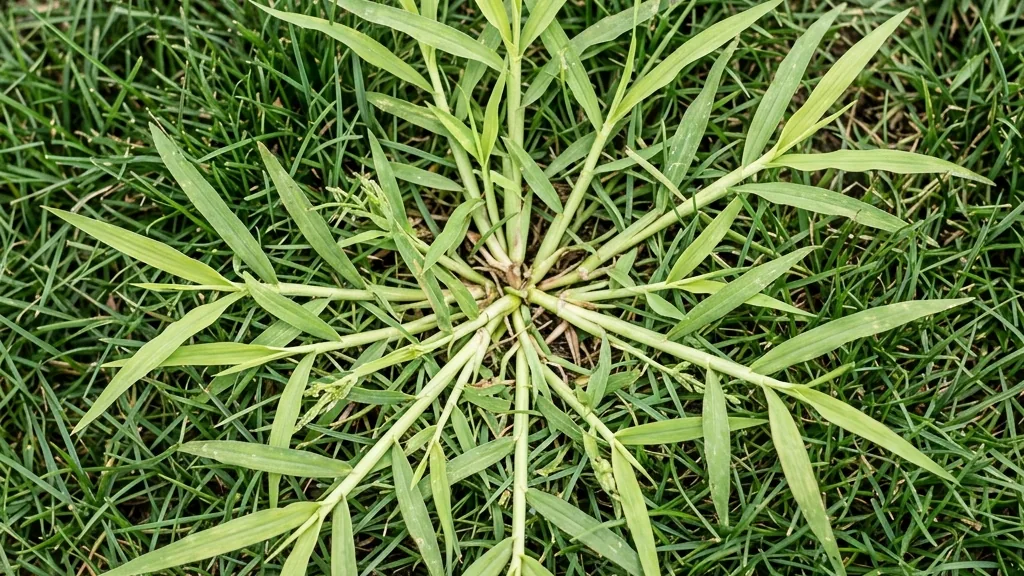
What does crabgrass look like? At a glance it is a low, star-shaped clump of coarse, light-green grass that sprawls flat against the soil and sends up thin, finger-like seed heads in mid to late summer. Up close, the giveaways are wide blades (noticeably broader than most lawn grass), a sprawling growth habit that radiates from a single central point like a crab’s legs, and those distinctive digitate seed stalks. This guide walks through every identifying feature – blades, sheaths, seed heads, color, and growth habit – then shows you how to tell crabgrass apart from the look-alikes people most often confuse it with.
Getting the ID right matters because crabgrass is an annual that lives and dies in one season but reseeds aggressively, and the control method depends entirely on correctly identifying it rather than a perennial grassy weed that needs a completely different approach. Misidentify it and you either waste a pre-emergent on the wrong target or miss the narrow window when control actually works.
The quick visual ID
Before the botanical detail, here is the at-a-glance picture most homeowners can use from a standing position:
- Growth habit: a flattened rosette that spreads outward from one center, often called “star” or “crab” shaped. Stems lie close to the ground and can root where the nodes touch soil.
- Color: usually a lighter, slightly yellow-green than surrounding turf, which is why a crabgrass patch often looks like a pale, coarse blotch in an otherwise uniform lawn.
- Texture: coarse and noticeably wider-bladed than fine fescues or Kentucky bluegrass.
- Seed heads: thin stalks topped with two to several finger-like spikes radiating from one point – the single most reliable late-season feature.
If a patch is low, pale, coarse, sprawling from a center, and topped with finger-like seed spikes in summer, you are almost certainly looking at crabgrass.
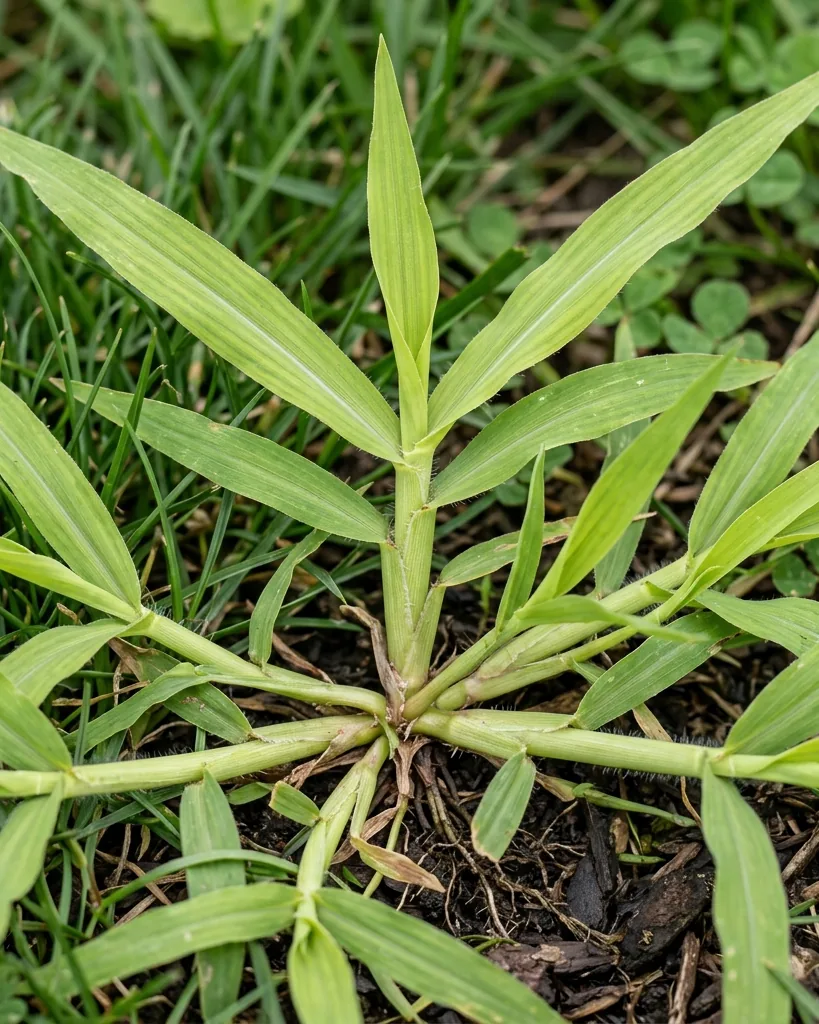
The leaf blades up close
Crabgrass blades are the first detail to check. They are relatively wide – several millimeters across – and taper to a point, with a rough or sparsely hairy surface depending on the species. According to University of Illinois Extension and UC Statewide Integrated Pest Management (UC IPM) identification references, the two common species differ here: large crabgrass (Digitaria sanguinalis) has conspicuous hairs on the leaf blade and the leaf sheath, while smooth or small crabgrass (Digitaria ischaemum) is largely hairless. Both have a short, membranous ligule (the small papery flap where the blade meets the stem), a feature that separates crabgrass from several look-alikes that have a fringe of hairs there instead.
The blade color leans yellow-green and the whole plant has a coarse, almost succulent feel compared with the fine, dark blades of a well-kept cool-season lawn. New summer seedlings can look deceptively grass-like, which is exactly why the sprawling habit and seed heads become the deciding features as the plant matures.
The seed heads: the most reliable feature
If you remember one thing, remember the seed heads. Crabgrass produces a digitate (finger-like) inflorescence: two to several slender spikes, called racemes, that all radiate from the top of a single stalk like the spokes of an umbrella or the fingers of a hand. The individual seed structures (spikelets) are tiny, on the order of 2 to 3 millimeters, and run in rows along each spike. Large crabgrass tends to have longer spikes and slightly larger spikelets than smooth crabgrass, but the radiating, finger-like arrangement is the shared signature.
This is the feature that distinguishes crabgrass from grasses whose seed heads form a single spike or a branched, open panicle. Once those finger-like stalks appear in mid to late summer, identification becomes straightforward even from a few feet away.
The growth habit: why it looks like a crab
The name is a clue. Crabgrass grows in a prostrate, spreading rosette: a central crown with stems that fan out flat in all directions, hugging the ground rather than standing upright. Where those stems contact moist soil at a node, they can root and anchor, which is how a single plant covers a surprising amount of ground by late summer. In a mowed lawn the plant stays low and flat – mowing barely touches it – which is part of why it thrives in turf that is cut short. That low, radiating sprawl is the structural feature that gives crabgrass both its name and its at-a-glance look.
Large vs. smooth crabgrass: the two you will actually meet
Most “crabgrass” is one of two species, and telling them apart sharpens your ID:
- Large (hairy) crabgrass, Digitaria sanguinalis: bigger overall, with hairy blades and sheaths, longer seed spikes, and a coarser look. It is the species most people picture.
- Smooth (small) crabgrass, Digitaria ischaemum: smaller and largely hairless, with shorter spikes and finer spikelets. It often shows up in shorter, closely mowed turf.
For control purposes the difference rarely matters – both are summer annuals managed the same way – but the hair test (hairy = large, smooth = small) is a quick way to confirm you are in the crabgrass genus rather than a look-alike.
Crabgrass vs. the look-alikes
This is where most misidentification happens, because several weeds and turf grasses share crabgrass’s coarse, light look. The differences are real once you know where to look.
| Plant | How to tell it from crabgrass |
|---|---|
| Goosegrass | Whitish, flattened center (“silvery” base), more tightly folded; per Rutgers NJAES it tillers about 3-4 weeks later than crabgrass, so it appears later in the season. |
| Tall fescue | A perennial bunchgrass with stiff, upright, dark-green blades and prominent veins; it does not sprawl flat or produce finger-like seed heads. |
| Quackgrass | A perennial that spreads by underground rhizomes (crabgrass has none), stands upright, and has clasping leaf “auricles” that wrap the stem. |
| Bermudagrass | Spreads by stolons and rhizomes and is a perennial; its seed head is finger-like too, but the gray-green color and creeping mat differ from crabgrass’s annual clumps. |
The single most useful distinction: crabgrass is a summer annual with no rhizomes that dies at first frost, while quackgrass, tall fescue, and bermudagrass are perennials. If you can pull the plant and find creeping underground stems, it is not crabgrass.
When and where crabgrass appears
Timing is part of the identification, because crabgrass follows a predictable phenology. University extension turf programs note that crabgrass seed germinates when soil temperatures at about the one-inch depth reach roughly 55 degrees Fahrenheit for several consecutive days, with peak germination of around 80% in the 60 to 70 degree range. A classic field indicator used across the Northeast and Midwest is forsythia: when forsythia shrubs finish blooming, soils are warming into crabgrass-germination territory. Seedlings emerge through spring and early summer, the plant tillers and sprawls through midsummer, throws seed heads in mid to late summer, and dies with the first hard frost.
Location helps too. Crabgrass favors hot, sunny, compacted, or thin spots – lawn edges along driveways and sidewalks (where pavement radiates heat), bare patches, and closely mowed turf. It is widely distributed and grows from sea level up to around 3,900 feet (about 1,200 meters) in elevation. A coarse pale patch along a hot sidewalk edge in July is a textbook crabgrass location.
Why it spreads so fast
Part of recognizing crabgrass is understanding why one plant becomes a patch. A single mature crabgrass plant can produce an enormous quantity of seed – extension sources cite figures on the order of 150,000 seeds per plant under good conditions – and those seeds can persist in the soil for years, germinating in successive seasons as conditions allow. That seed bank is why crabgrass returns even after a clean year, and why identification in summer (before the seed heads mature and shed) is the moment that matters most for breaking the cycle. A thick, properly mowed lawn, supported by good lawn care and, in beds, a weed-suppressing layer of mulch, is the most durable way to deny crabgrass the bare, hot soil it needs to start.
Crabgrass through the season: a month-by-month look
Because crabgrass is a summer annual, its appearance changes predictably through the year, and knowing the calendar makes identification far easier.
Early spring. Nothing is visible yet – last year’s plants are dead and the seed bank sits dormant in cool soil. This is the window before germination.
Mid-spring (germination). Once soil at the one-inch depth holds about 55°F for roughly 48 hours to a few consecutive days, the first seeds sprout. Forsythia finishing its bloom is the classic visual cue. Seedlings are small and easy to miss, with just two or three wide, pale blades.
Late spring to early summer. Seedlings begin to sprawl and the flat, radiating habit appears. Germination peaks as soils warm into the 70°F range, so a patch can seem to appear “overnight.” Goosegrass, a frequent look-alike, typically lags crabgrass by about 4 weeks, so anything sprouting noticeably later may be goosegrass instead.
Midsummer. Plants tiller, thicken, and spread outward, hugging the ground. The pale color stands out against the lawn – this is when crabgrass is most obvious as a coarse blotch.
Late summer. The finger-like seed heads appear and mature: the most reliable ID feature and the last chance to act before seed sheds into the soil bank.
Fall. The first hard frost kills the plant outright; it browns and collapses, leaving only seed behind for next year.
A close-up confirmation check
If you want certainty, get down to the plant and run through this quick sequence:
- Pull a stem and look for underground runners. Crabgrass has none. If you find white, creeping rhizomes, it is a perennial like quackgrass or bermudagrass, not crabgrass.
- Check the base for hairs. Hairy blades and sheath point to large crabgrass; a smooth, hairless base points to small crabgrass. Either confirms the genus.
- Find the ligule. Crabgrass has a short, membranous (papery) ligule where the blade meets the stem – not a fringe of hairs.
- Measure a spikelet. The individual seed structures are tiny – roughly 2 mm on small crabgrass and closer to 3 mm on large crabgrass – arranged in neat rows along each finger-like spike.
- Read the whole plant’s posture. Flat, radiating, and low to the ground is crabgrass; upright and clumping is more likely a fescue or other bunchgrass.
Run those five checks and you can separate crabgrass from nearly every common look-alike with confidence, even before the seed heads form.
Common mistakes when identifying crabgrass
A few errors send homeowners down the wrong path:
- Calling every coarse weed “crabgrass.” Goosegrass, tall-fescue clumps, and young bermudagrass all get blamed on crabgrass. The rhizome test and the seed-head shape settle it.
- Trying to identify it too early. Spring seedlings are genuinely hard to tell apart; waiting until the plant sprawls or seeds removes the guesswork.
- Assuming a perennial. Because a patch returns each year, people assume the same plants survived. They did not – it is the seed bank regrowing, which changes the timing of any response.
- Ignoring location clues. Hot, compacted edges and thin, bare spots are crabgrass’s signature habitat; a coarse patch in deep shade is more likely something else.
- Expecting mowing to remove it. Crabgrass shrugs off mowing because it grows flat, so “I cut it and it’s still there” is expected, not a sign of misidentification.
Slow down, use the close-up checks, and let the season do some of the work – the mature plant identifies itself.
Crabgrass identification at a glance
| Feature | What to look for |
|---|---|
| Growth habit | Low, flat, star/crab-shaped sprawl from one center |
| Color | Pale, yellow-green; coarser than surrounding turf |
| Blades | Wide, tapering; hairy (large) or smooth (small) species |
| Seed heads | Finger-like spikes radiating from one point, mid-late summer |
| Lifecycle | Summer annual; no rhizomes; dies at frost |
Is crabgrass actually a problem?
Identifying crabgrass usually raises the question of whether it matters. It is not toxic and it does hold soil, but in a lawn it is generally unwanted for three reasons: it looks coarse and pale against fine turf, it dies at frost and leaves bare brown patches all winter, and each plant reseeds heavily, so a small infestation compounds season over season. In garden beds and on bare ground it is less of a concern and can even act as a temporary green cover, though its prolific seeding means it rarely stays put. The practical point is that identification drives the decision: a few plants in an out-of-the-way corner may not be worth treating, while a spreading patch in a prized lawn is worth interrupting before it seeds. Knowing what you are looking at – a reseeding summer annual, not a permanent invader – is what lets you choose a proportionate response instead of overreacting to a plant that will die on its own at the first frost.
Frequently asked questions
How can I tell crabgrass from regular grass?
Crabgrass is coarser and paler, sprawls flat in a star shape from a central point rather than growing upright, and produces finger-like seed heads in summer. Lawn grasses grow more uniformly upright and do not radiate flat from one crown.
What does young crabgrass look like?
Seedlings look grass-like at first, with a few wide, light-green blades, but they quickly begin to sprawl outward and stay low. The flattening, radiating habit is the early tell before seed heads form.
Is crabgrass the same as quackgrass?
No. Crabgrass is a summer annual with no underground stems that dies at frost, while quackgrass is a perennial that spreads by rhizomes and persists year-round. Finding creeping underground stems means it is not crabgrass.
When does crabgrass show up?
It germinates once soil at the one-inch depth holds around 55 degrees Fahrenheit for several days – roughly when forsythia finishes blooming – then sprawls through summer and sets seed heads in mid to late summer.
Why do I have crabgrass only along my driveway?
Pavement radiates heat and the soil there is often compacted, thin, and dry – exactly the hot, bare conditions crabgrass exploits. Edges and thin spots are its favorite footholds.
Does crabgrass come back every year?
The plant itself dies each fall, but it leaves behind a large, long-lived seed bank, so new plants germinate the next season. That is why interrupting it before the seed heads mature matters so much.
What to do once you have identified it
Confirming crabgrass is the first step; the identification then points to the right timing for action. Because it is a summer annual that emerges from seed, the most effective intervention is preventing germination – a pre-emergent applied when soils approach that 55-degree threshold in spring, before seedlings appear. Once plants are visible and sprawling, pre-emergents no longer help, and the focus shifts to removing or spot-treating individual plants before their seed heads mature in late summer, plus thickening the lawn so bare, hot soil never gives the next generation a foothold. Hand-pulling works on small numbers when the soil is moist, since crabgrass has no deep rhizomes to regrow from.
The most durable strategy, though, is cultural: a dense lawn mowed at the taller end of its recommended height shades the soil surface, and crabgrass seed needs warm, lit soil to germinate. In other words, the same identification that tells you what you have also tells you when its weak points are – the germination window in spring and the seed-set window in late summer – so you can work with the calendar rather than against it.
Sources and further reading
- University of Illinois Extension
- UC Statewide Integrated Pest Management Program (UC IPM)
- Rutgers New Jersey Agricultural Experiment Station (NJAES)
About the author
Linnea Bendwell writes about lawns, weeds, and home gardening, with a focus on helping homeowners identify what is actually growing in their yard before they treat it. This article is educational; for control decisions, follow your local extension office’s current regional guidance, which accounts for your climate and grass type.