A cubic yard of mulch covers about 108 square feet at 3 inches deep, 162 square feet at 2 inches, or 324 square feet spread just an inch thick, and it weighs anywhere from 400 to 1,000 pounds depending on the material and how wet it is. Those two numbers, coverage and weight, are the whole game when you are ordering mulch, and most calculators give you the first and skip the second. Then you show up with a half-ton pickup, watch the loader drop a yard in the bed, and realize the rear suspension is sitting on the bump stops. I have made that mistake. This guide makes sure you do not.
Here I will walk through exactly what a cubic yard is, how far it goes at every depth, how much it weighs and whether it fits in your truck, when bulk beats bagged, and how to measure an oddly shaped bed without a calculator. By the end you will be able to order the right amount in one shot, haul it without wrecking your vehicle, and avoid both the second trip and the leftover pile that sits in your driveway until July.
What a Cubic Yard of Mulch Actually Is
A cubic yard is a cube three feet on every side: 3 feet long by 3 feet wide by 3 feet tall. Multiply that out and you get 27 cubic feet of material. That is the unit bulk yards and landscape suppliers sell in, and it is why a single “yard” of mulch looks like a small mountain when it lands on your driveway. It is roughly the volume of a standard washing machine, give or take.
Bagged mulch is sold in cubic feet, usually 2 cubic foot bags. Since a yard is 27 cubic feet, one cubic yard equals about 13 and a half of those 2 cubic foot bags, or 9 of the larger 3 cubic foot bags. Hold onto that conversion, because it is the key to deciding whether to buy bulk or bagged, which I will get to.
How Much Does a Cubic Yard of Mulch Cover?
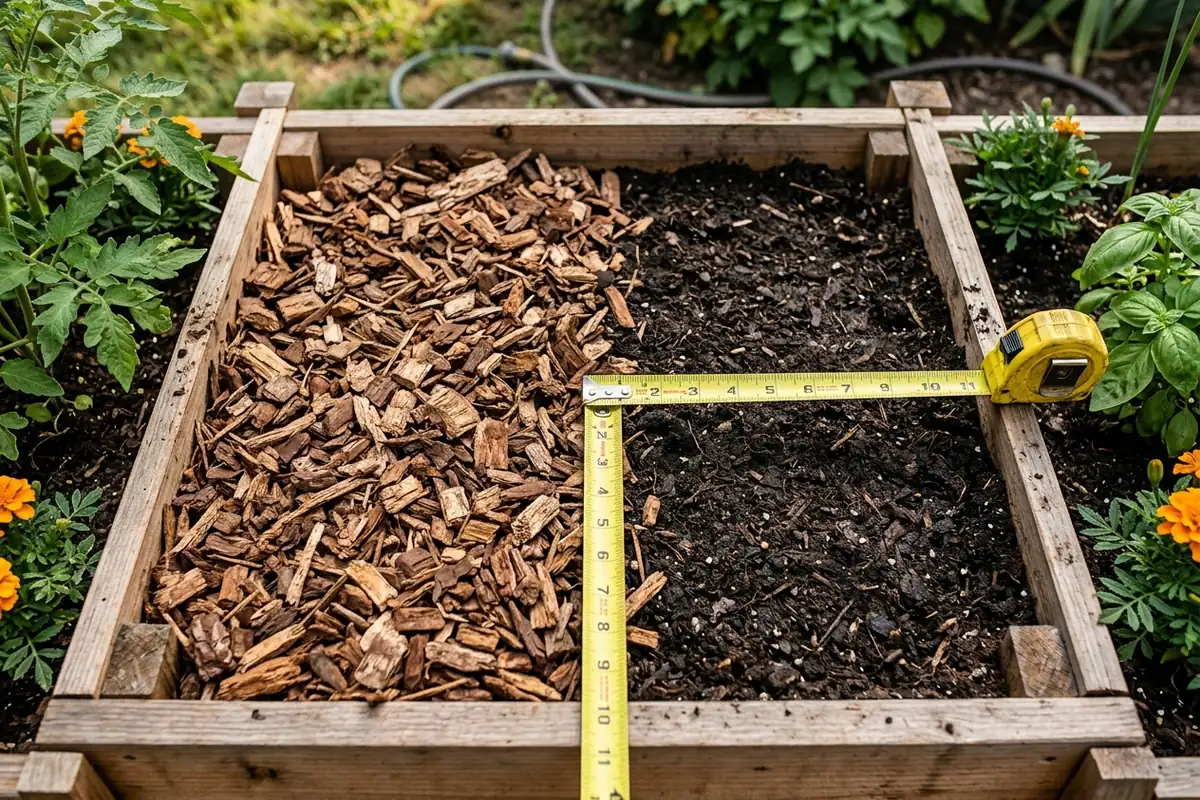
Coverage depends entirely on depth. The math is simple: 324 square feet at 1 inch, and you divide by the number of inches for any other depth. Here is the table I keep in my head.
| Depth | Coverage from 1 cubic yard | Typical use |
|---|---|---|
| 1 inch | 324 sq ft | Light refresh over existing mulch |
| 2 inches | 162 sq ft | Perennial beds, around seedlings |
| 3 inches | 108 sq ft | New beds, shrubs, trees (the standard) |
| 4 inches | 81 sq ft | Paths, winter crown protection |
The 3 inch column is the one most people need, so a good rule of thumb is one yard per roughly 100 square feet of bed. Measure your beds, total the square footage, divide by the coverage at your chosen depth, and add about 10 percent for settling and the inevitable bit that ends up on the lawn. The Old Farmer’s Almanac mulch calculator does this same math if you would rather punch in numbers, and it lets you break an irregular bed into rectangles.
A Worked Example, Start to Finish
Numbers in the abstract are easy to fumble, so let me run a real yard the way I would for my own place. Say I have three beds: a front border that is 30 feet long and 4 feet wide, a side strip 20 feet by 3 feet, and a round bed under a maple with about a 5 foot radius. The front border is 120 square feet. The side strip is 60 square feet. The circle is 5 times 5 times 3.14, which is about 78 square feet. Total: 258 square feet.
I want 3 inches on the new front border and 2 inches on the rest, but to keep it simple I will plan the whole job at 3 inches, which is the safe over-estimate. At 3 inches, one yard covers 108 square feet, so 258 divided by 108 is 2.4 yards. Add 10 percent for settling and spillage and I am at about 2.6 yards. I would order 3 yards, knowing the extra half-yard tops off thin spots and dresses a container or two. That single decision, rounding up to 3 instead of ordering exactly 2.4, is what keeps me from a second delivery fee that would cost more than the extra material.
Notice what the example does that a bare calculator does not: it forces you to actually walk your yard, list every bed, and decide a depth for each before you commit. Ninety percent of mulch-ordering mistakes come from forgetting a bed or guessing the depth, not from bad arithmetic. Write the beds down.
How Much Does a Cubic Yard of Mulch Weigh?
This is the number nobody tells you and the one that strands people at the supply yard. A cubic yard of wood mulch weighs roughly 400 to 800 pounds when dry. Soaked from rain, that same yard can hit 1,000 pounds or more, because wood drinks water. Other materials differ a lot:
| Material | Approx. weight per cubic yard |
|---|---|
| Dry wood / bark mulch | 400-800 lb |
| Wet wood mulch | 800-1,000+ lb |
| Compost | 1,000-1,600 lb |
| Rubber mulch | about 1,500 lb |
Why it matters: a standard half-ton pickup (the F-150, Silverado 1500, Ram 1500 class) has a payload limit, often around 1,500 to 2,000 pounds, and that limit includes you, your passengers, and the tailgate full of tools. By volume the bed might swallow two yards of mulch, but by weight, one yard of wet mulch can already eat most of your payload. The safe move for a half-ton is one yard at a time, dry if you can get it. If you need two or three yards, pay for delivery. It usually costs less than a damaged suspension and a chiropractor visit.
How Deep Should You Spread It?
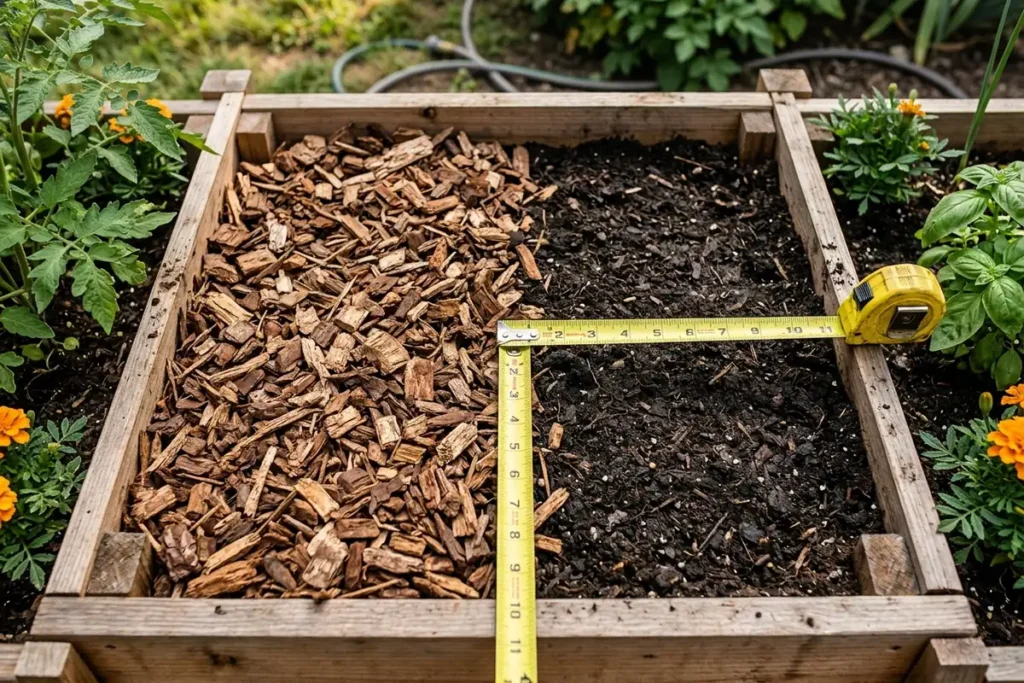
Depth is not one-size-fits-all, and getting it right changes how much you order. Three inches is the workhorse depth for new beds, shrubs, and around trees, deep enough to block weeds and hold moisture without smothering roots. Drop to 2 inches around perennials and anything shallow-rooted, and to 1 to 2 inches near seedlings and direct-sown plants. Go thicker, 3 to 4 inches, for pure weed-suppression on a path or for winter crown protection in cold zones. The Old Farmer’s Almanac mulching guide recommends 3 to 4 inches of winter mulch to keep frozen ground fully covered, which is the one time I deliberately go deep.
One universal rule regardless of depth: keep mulch off trunks and stems. Pull it back a few inches from anything woody and never build a volcano cone against a tree. That habit has nothing to do with quantity and everything to do with not rotting your plants.
Bulk Yard Versus Bagged: When Each Wins
Here is the break-even most articles dance around. A cubic yard equals about 13 and a half 2 cubic foot bags. So compare the delivered price of a bulk yard against 13.5 times the price of one bag. Bulk almost always wins on price once you need a yard or more, often by a wide margin, and you skip the plastic. Where bagged wins is small jobs, tidy storage, and access: bags fit in a car trunk, stack in a garage, and you open only what you need so the rest does not weather in a pile.
My rule: under about 8 to 10 bags worth of mulch, buy bags. Over that, get a bulk yard delivered and save real money. The crossover happens fast because bulk pricing per cubic foot runs well below bagged. The exceptions are when you have no place to dump a loose pile, no way to move it from the driveway to the beds, or you genuinely need only a bag or two for a container or a small border.
How Often You Reorder Depends on the Material
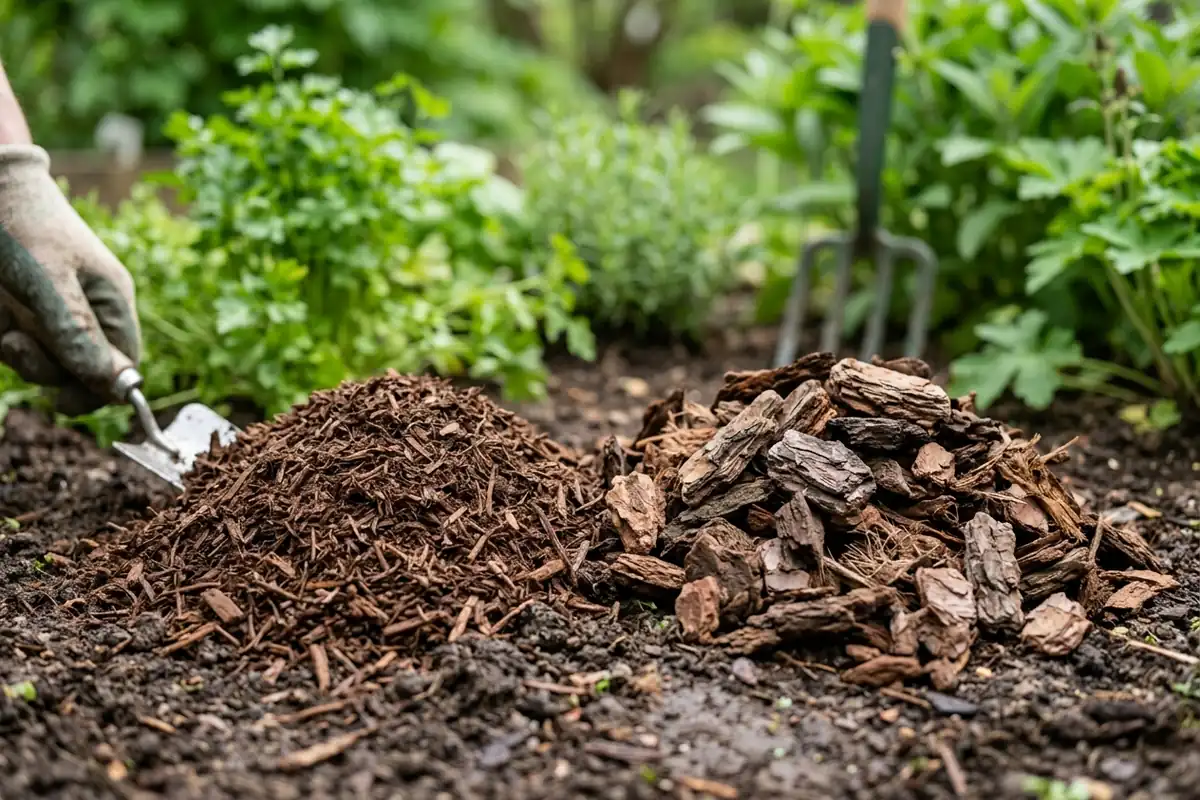
One yard is not a one-time purchase, and how soon you buy the next one depends entirely on what you spread. This changes the math on whether a single yard is enough for the season. Fast-decaying mulches like straw or fine shredded hardwood break down and thin out within a single season, so you are topping up that 3 inch layer again next spring. Slow mulches like cedar or large bark nuggets hold their depth for two or three years, so one good order rides you a long way.
That difference is worth pricing out. A cheaper mulch you replace every year can cost more over three seasons than a pricier mulch you buy once. When I plan a bed, I decide the material first, estimate how many years it lasts, and only then figure the per-year cost. A yard of slow bark at a higher sticker price often wins on a three-year view, while a yard of straw makes sense in a vegetable bed I am going to dig and replant anyway. Match the lifespan to how long you want to leave the bed alone, and the reorder schedule sorts itself out.
What It Takes to Spread a Yard
People underestimate the labor as badly as they underestimate the weight. Moving one yard of mulch from a driveway pile to the beds is real work: figure on filling and dumping a wheelbarrow somewhere between 9 and 14 times for a single yard, then raking it level. For most people that is a solid half-day for two or three yards, longer if the beds are far from the drop spot or uphill. Plan the drop carefully. Ask the delivery driver to put the pile as close to the beds as the driveway allows, and lay a tarp down first so cleanup is a matter of dragging the tarp rather than sweeping stained concrete.
A few tools make it faster: a mulch fork or a flat-tined manure fork moves shredded mulch far better than a shovel, and a leaf rake flipped tines-up levels it smoothly without gouging the soil. If you have a long haul, a contractor wheelbarrow with a single front wheel tips and dumps more easily than the two-wheel garden carts. None of this is glamorous, but knowing the effort up front is the difference between finishing in an afternoon and abandoning a half-spread pile that bakes in the sun for a week.
How to Measure an Odd-Shaped Bed
Calculators assume you already know your square footage, but real beds curve and wander. The trick is to break the bed into simple shapes, measure each, and add them up. A long border becomes a rectangle: length times width. A round bed around a tree is a circle: radius times radius times 3.14. An irregular blob splits into two or three rectangles laid end to end, and you accept a little rounding. Total the square feet, then use the coverage table above for your depth.
For a quick gut-check on a whole front yard of beds, walk it off in paces. A normal adult stride is roughly 3 feet, so pacing the length and width of each bed gets you close enough to order without dragging out a tape measure. I round up a hair every time, because running short means a second delivery fee, and that erases any savings from ordering tight.
Ordering Tips That Save a Second Trip
A few practical points after years of doing this. Order on the high side and add 10 percent; settling, spillage, and that one bed you forgot always eat into the pile. Ask whether the yard is selling by loose volume or compacted, because a tightly packed scoop is not the same as a fluffed yard. Time bulk deliveries for a dry stretch, since wet mulch is heavier to move and more likely to be sour if it sat in a soggy pile. And spread within a few days; a fresh loose pile left for weeks can heat up and ferment in the center.
Mulch is also a good moment to think about what is going under it. If you are mulching a fresh planting, our notes on native trees and shrubs cover what to put in the ground first, and if you are topping a lawn-adjacent bed, the same depth math applies whether you read our piece on small garden lawn care or just eyeball the edge.
Frequently Asked Questions
How much does a cubic yard of mulch cover?
About 108 square feet at 3 inches deep, 162 square feet at 2 inches, or 324 square feet at 1 inch. Three inches is the standard for beds and trees, so a yard covers roughly 100 square feet for most jobs. Add about 10 percent extra for settling and spillage.
How many bags equal a cubic yard of mulch?
About 13.5 bags if they are the common 2 cubic foot size, or 9 bags of the 3 cubic foot size. A cubic yard is 27 cubic feet, so divide 27 by the bag size to get the count.
How much does a cubic yard of mulch weigh?
Dry wood mulch runs 400 to 800 pounds per yard, and wet mulch can exceed 1,000 pounds. Compost is heavier, around 1,000 to 1,600 pounds, and rubber mulch about 1,500. Weight matters more than volume when you are hauling it yourself.
Will a cubic yard of mulch fit in a pickup truck?
By volume, yes, a full-size bed holds two to three yards. By weight, a half-ton pickup should carry only one yard at a time, especially if the mulch is wet, because a single wet yard can use most of your payload limit. For more than a yard, get it delivered.
Is it cheaper to buy mulch in bulk or in bags?
Bulk is cheaper once you need a yard or more, since a yard equals about 13.5 bags and bulk pricing per cubic foot is well below bagged. Bags win for small jobs, easy storage, and when you have no place for a loose pile.
How many cubic yards of mulch do I need?
Measure your beds in square feet, then divide by the coverage at your depth: 108 for 3 inches, 162 for 2 inches. Most home landscapes need 2 to 4 yards. Round up and add 10 percent so you do not come up short.
Bottom Line
A cubic yard of mulch is 27 cubic feet that covers roughly 100 square feet at the standard 3 inch depth and weighs as much as a small motorcycle once it is wet. Order by measuring your beds, dividing by the coverage for your depth, and adding 10 percent, then decide bulk versus bagged at the 8 to 10 bag crossover. Most important, respect the weight: haul one yard at a time in a half-ton truck, or pay for delivery and save your back and your suspension. Get those numbers right and you mulch the whole yard in one weekend with nothing left rotting in the driveway.