The Monstera Burle Marx Flame is a climbing aroid prized for its deeply cut, almost flame-shaped leaves, and caring for it well comes down to four things: bright indirect light, careful watering, ordinary household humidity, and a pole to climb. Despite a reputation as a fussy collector’s plant, it is genuinely forgiving once you understand what it needs, and most of the trouble owners run into comes from overwatering or guessing at its identity. This guide covers how to identify the plant, exactly how to care for it with real numbers, what it costs, and – importantly for a pet household – how toxic it is and what to do if it is eaten.
I have grown and propagated aroids for years, and the Burle Marx Flame rewards patience more than fussing. It is a slow, deliberate grower that climbs rather than bushes out, so the single biggest difference between a sad plant and a thriving one is usually a support to climb and a watering hand that waits for the soil to dry.
What is the Monstera Burle Marx Flame?
This is where most care pages stay vague, so it is worth being clear. The Burle Marx Flame is a member of the genus Monstera in the arum family (Araceae), and its exact taxonomic status has been debated – it has circulated as a possible undescribed species, a form, or a variety rather than a settled, named species. It is named in honor of Roberto Burle Marx, the celebrated Brazilian landscape architect whose garden estate, the Sitio Burle Marx, was named a UNESCO World Heritage Site in 2021. The plant is sometimes confused in the trade with names like “dilacerata,” which actually belongs to a different plant, and that mislabeling is part of why identification matters.
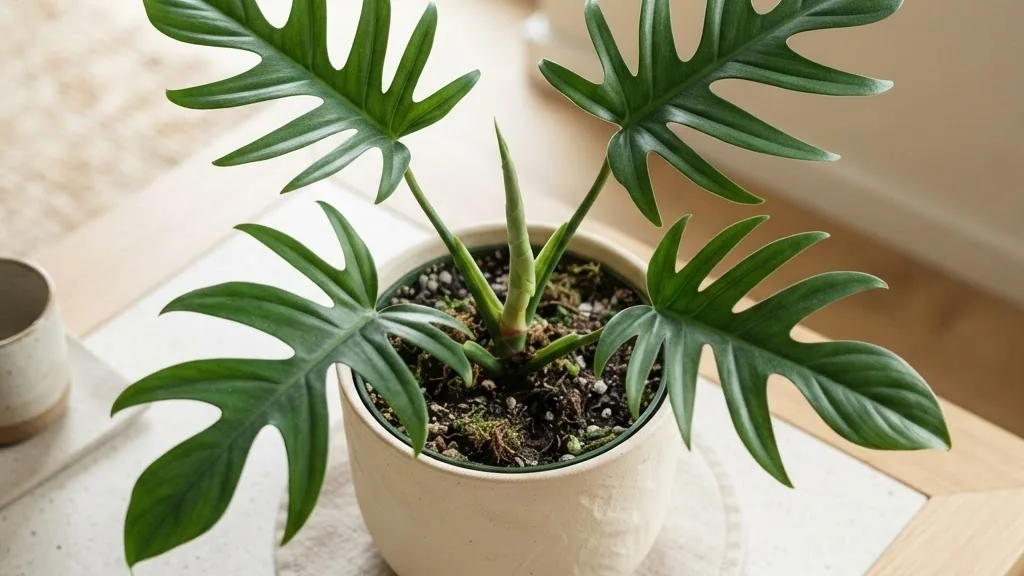
What you can rely on is the look: as it matures and climbs, the leaves develop deep lobing and narrow segments that give the “flame” impression, distinct from the round, hole-punched fenestration of a typical Monstera deliciosa.
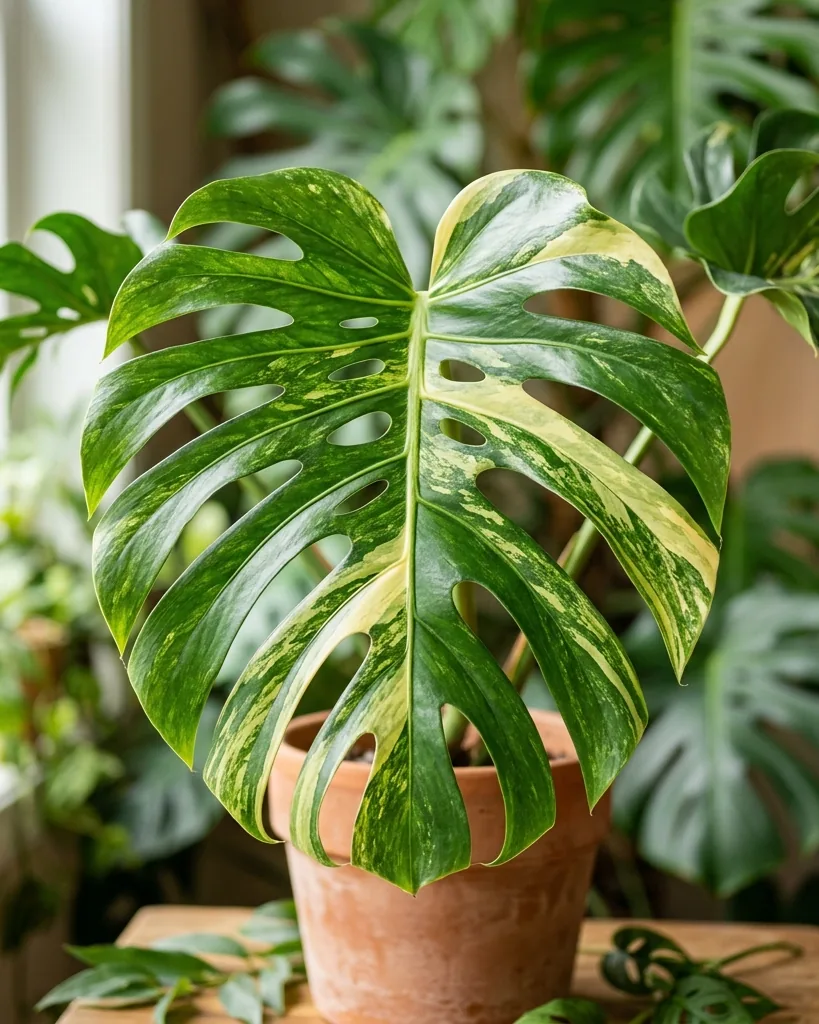
How to identify it (and tell it from look-alikes)
Because it is often mislabeled, identification is a real skill with this plant. Key features to check:
- Leaf shape: elongated leaves with deep, narrow lobes cut toward the midrib, creating a feathered, flame-like outline as the plant matures – not the oval, hole-fenestrated leaf of M. deliciosa.
- Climbing habit: a true climber that wants a moss or coir pole; juvenile leaves are smaller and less divided, maturing as the plant gains height.
- Texture and growth: a relatively compact, slow climber rather than a sprawling giant.
It is most often confused with Monstera deliciosa var. sierrana, the common “var. Brazil” forms, and even Epipremnum pinnatum. The deep, narrow flame lobing and the climbing, slow habit are the distinguishing cues. When buying, treat the label with healthy skepticism and judge by the leaf, because mislabeled stock is common at the prices this plant commands.
Light: the single most important factor
Light drives everything else. The Burle Marx Flame wants bright, indirect light – think an east- or west-facing window within about three feet of the glass, or a few feet back from a bright south window. In measured terms, growers target a minimum of roughly 1,000 foot-candles (about 10% of full sun) for steady growth, with brief exposure up to around 3,500 foot-candles (about 35% of sun) tolerated for a few hours. Too little light and the plant stalls, the new leaves stay small and barely lobed, and the soil stays wet long enough to rot the roots. Direct midday sun, on the other hand, scorches the foliage. Bright but filtered is the sweet spot, and it is also what coaxes the dramatic mature leaf shape to develop.
Watering: wait for the soil to dry
Overwatering is the number-one killer of this plant. Water thoroughly, then let the top inch or two of the mix dry before watering again – in practice that usually lands at about once every 1 to 2 weeks, but you should water by feel and by season, not by the calendar. The plant drinks more in bright, warm, growing months and far less in winter. The classic feedback signals are easy to read: brown, crispy leaf edges point to underwatering or low humidity, while yellowing lower leaves and a sour, soggy mix point to overwatering. When in doubt, wait – an aroid recovers from a missed watering far more easily than from sitting in wet soil.
Humidity and temperature
Here is the reassuring part: the Burle Marx Flame does not need a steamy greenhouse. Average home humidity in the 40 to 60% range is plenty, and many growers report that even 35 to 45% works fine. What you want to avoid is the opposite extreme – sustained humidity above about 75% with poor airflow can actually encourage rot and mold rather than help. A normally comfortable room, kept away from cold drafts and heating vents, suits it well. On temperature, treat it as a tropical: comfortable room temperatures suit it, and it should be protected from anything near freezing, as cold damage is hard to reverse.
Soil and fertilizer
As an epiphytic climber, this Monstera wants an airy, chunky mix rather than dense potting soil. A typical aroid blend – potting mix loosened with orchid bark, perlite, and a little coco coir or charcoal – gives the roots the oxygen they need and drains fast enough to prevent the wet feet that cause rot. Choose a pot with drainage holes and resist the urge to overpot; these plants prefer to be a touch snug.
Feeding is light. During the active growing season, a dilute balanced houseplant fertilizer applied at roughly the cadence the package suggests – or a “weakly, weekly” diluted feed – keeps it growing without burning the roots. Cut fertilizer back sharply in the low-light months when growth naturally slows. More food does not buy faster growth; light does.
Growth, size, and support
Set expectations: this is a slow, deliberate plant. In good light it pushes roughly one new leaf every 5 to 6 weeks, and each new leaf tends to be a little larger and more divided than the last. Given a support, it climbs and can eventually reach over 6 feet (about 1.8 meters) tall indoors. The support is not optional if you want those mature, flame-shaped leaves: a sturdy moss or coir pole (or a bamboo stake or trellis) lets the plant attach its aerial roots and “tells” it to produce adult foliage. Without something to climb, it sprawls and stays in a smaller-leaved juvenile form. Guide the new growth onto the pole as it develops, and keep the pole lightly moist to encourage the aerial roots to grip.
One detail that confuses new owners is the aerial roots – the thick roots that emerge from the stem and reach toward the pole. They are normal and healthy, so do not cut them off. Their job is to grip the support and help the plant draw moisture, so guide them onto a damp moss pole rather than trimming them. If a few reach into the air and dry out, that is fine and nothing to fix. Tucking them into the pole, on the other hand, encourages the plant to climb and to commit to producing the larger, more deeply lobed adult leaves that make this Monstera worth growing in the first place.
Is the Monstera Burle Marx Flame toxic to pets and children?
Yes – and this matters in any home with cats, dogs, or small children. Like other Monstera and most aroids, the Burle Marx Flame contains insoluble calcium oxalate crystals throughout its tissues. According to the ASPCA, plants in this group are toxic to cats and dogs: when an animal (or person) bites or chews a leaf, the needle-like crystals are released and cause immediate oral irritation. Typical signs include intense mouth and tongue irritation, drooling, pawing at the mouth, vomiting, and difficulty swallowing.
The reassuring context is that because the reaction is immediate and painful, animals rarely consume a large amount, and serious outcomes are uncommon – but it is still genuinely unpleasant and warrants action. If a pet or child chews the plant, wipe out the mouth and offer water or something cold to soothe the irritation, and in the first 30 minutes contact a professional rather than waiting: the ASPCA Animal Poison Control Center (888-426-4435) for pets, or Poison Control for a child. Keep the plant up high or in a room your pets cannot access, and wash your hands after pruning, since the sap can irritate skin and eyes too.
What it costs and why
The Burle Marx Flame earned its reputation partly through price. At the houseplant-collecting peak of 2020-21 it changed hands for as much as $2,000 to $15,000, with rare large specimens at the top of that range. As propagation caught up with demand, prices fell sharply – by early 2023 cuttings were commonly around $500 to $1,000 per node, and they have continued to come down as the plant became more widely available. If you are buying today, judge value by the size and rooting of the plant and the trueness of the leaf, not by the old hype, and be wary of suspiciously cheap “Burle Marx Flame” listings that turn out to be a mislabeled common Monstera.
Common problems and quick fixes
- Yellowing lower leaves: usually overwatering. Let the mix dry further, check that the pot drains, and loosen dense soil.
- Brown, crispy edges: underwatering or very dry air near a heat source; water more consistently and move it off the vent.
- Small, barely lobed new leaves: not enough light, or no support to climb. Brighten the spot and add a pole.
- No new growth: normal in low-light winter months; growth resumes as days lengthen.
- Pests (spider mites, thrips, mealybugs): inspect new growth and leaf undersides; treat early with insecticidal soap or neem and isolate the plant.
If you grow other tropicals, the same airy mix, bright indirect light, and dry-down watering that suit your houseplants generally will suit this one, so it slots neatly into an existing collection.
How to propagate the Burle Marx Flame
Because cuttings have real value, propagation is worth doing carefully. This plant propagates from stem cuttings that include at least one node – the joint where a leaf and aerial root emerge – since the node, not the leaf, is what grows new roots and shoots. A cutting with a node and one healthy leaf is the standard unit, and historically these node cuttings are exactly what changed hands for hundreds of dollars at the plant’s peak.
To propagate, use a clean, sharp blade and cut just below a node. Let the cut callus for an hour or two, then root it one of three common ways: in water (change it regularly and pot up once roots reach an inch or two), in damp sphagnum moss (which keeps humidity high around the node), or directly in a light, airy aroid mix kept lightly moist. Warmth, bright indirect light, and patience do the rest; new roots typically appear over a few weeks, followed by a new shoot.
Propagate in spring or summer when the parent is in active growth, not in the dim winter months when a rootless cutting can stall and rot before it establishes. Avoid taking many single-node cuttings from a young plant at once, since it stresses the parent and slows everyone down – one healthy node at a time is the reliable path.
When and how to repot
The Burle Marx Flame likes to be a little snug, so it does not need frequent repotting. Move it up a pot size only when roots circle the bottom, emerge from the drainage holes, or the plant dries out within a day or two of watering – usually every year or two. Choose a container only one size larger; overpotting surrounds the roots with soil that stays wet and invites rot.
Spring or early summer, when the plant is actively growing, is the best time. Refresh the chunky aroid mix, settle the moss pole firmly so the climbing plant stays stable, and water lightly once repotted, then resume normal care. If you find dark, mushy roots, trim them back to firm, pale tissue and ease off watering while the plant recovers – soft, rotted root is almost always a sign the old mix held too much water.
Where to place it in your home
Placement decides how well this plant does more than any product you can buy for it. The ideal spot is bright but out of direct sun, with a little room around the foliage for airflow and away from the dry blast of a heating or cooling vent. East- and west-facing windows are usually perfect; a north window is often too dim for strong growth, and an unfiltered south window can scorch the leaves unless the plant sits back from the glass or behind a sheer curtain.
Because it climbs, give it vertical room and a pole rather than a wide, low surface. Bathrooms and kitchens with good natural light can suit it thanks to their slightly higher humidity, as long as airflow is decent. The same principles that guide the rest of your indoor growing – light first, then airflow, then convenience – apply cleanly to this Monstera.
Care at a glance
| Factor | What it wants |
|---|---|
| Light | Bright indirect; ~1,000-3,500 foot-candles, no harsh midday sun |
| Water | When top 1-2 inches dry, about every 1-2 weeks |
| Humidity | 40-60% is plenty; avoid sustained 75%+ with poor airflow |
| Soil | Chunky aroid mix (bark, perlite, coir); fast-draining |
| Support | Moss or coir pole for mature, flame-shaped leaves |
| Toxicity | Toxic to cats and dogs (calcium oxalate) – keep out of reach |
Frequently asked questions
Is the Monstera Burle Marx Flame a rare plant?
It was rare and very expensive during the 2020-21 houseplant boom, selling for thousands of dollars, but propagation has made it far more available and affordable since, with node cuttings dropping to the hundreds.
How much light does it need?
Bright indirect light – roughly 1,000 foot-candles minimum, up to about 3,500 for short periods. An east or west window within a few feet of the glass is ideal; avoid harsh direct midday sun.
How often should I water it?
Water when the top inch or two of the mix is dry, which usually works out to about every 1 to 2 weeks. Adjust for season and light, and never let it sit in soggy soil.
Does it need high humidity?
No. Average home humidity of 40-60% is fine, and 35-45% works for many growers. Sustained humidity above about 75% with poor airflow can actually cause rot.
Is it toxic to cats and dogs?
Yes. Like other Monstera, it contains insoluble calcium oxalate crystals and is listed as toxic to cats and dogs by the ASPCA, causing mouth irritation, drooling, and vomiting if chewed. Keep it out of reach and call the ASPCA Animal Poison Control Center (888-426-4435) if ingested.
Why are my new leaves small and not lobed?
Too little light, no support to climb, or both. Move it brighter and give it a moss or coir pole; mature, flame-shaped leaves develop as the plant climbs in good light.
Sources and further reading
- ASPCA – Toxic and non-toxic plants
- Costa Farms – houseplant care resources
- The Sill – plant care guides
About the author
Linnea Bendwell writes about houseplants and gardening, with a focus on aroids and practical, no-nonsense care. She grows and propagates Monstera and related plants at home. This article is educational and not veterinary advice; if a pet ingests any part of a toxic plant, contact your veterinarian or the ASPCA Animal Poison Control Center.