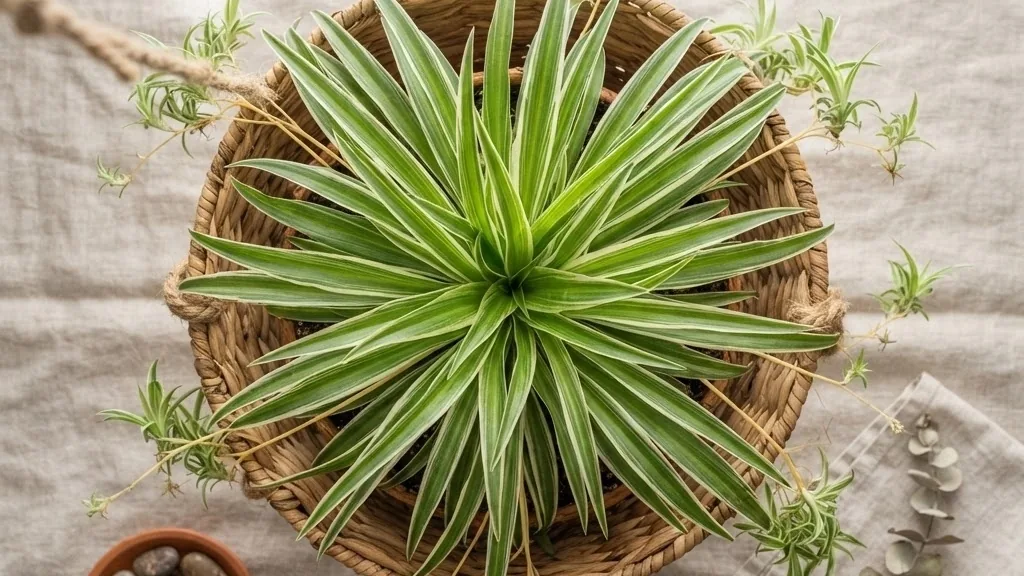
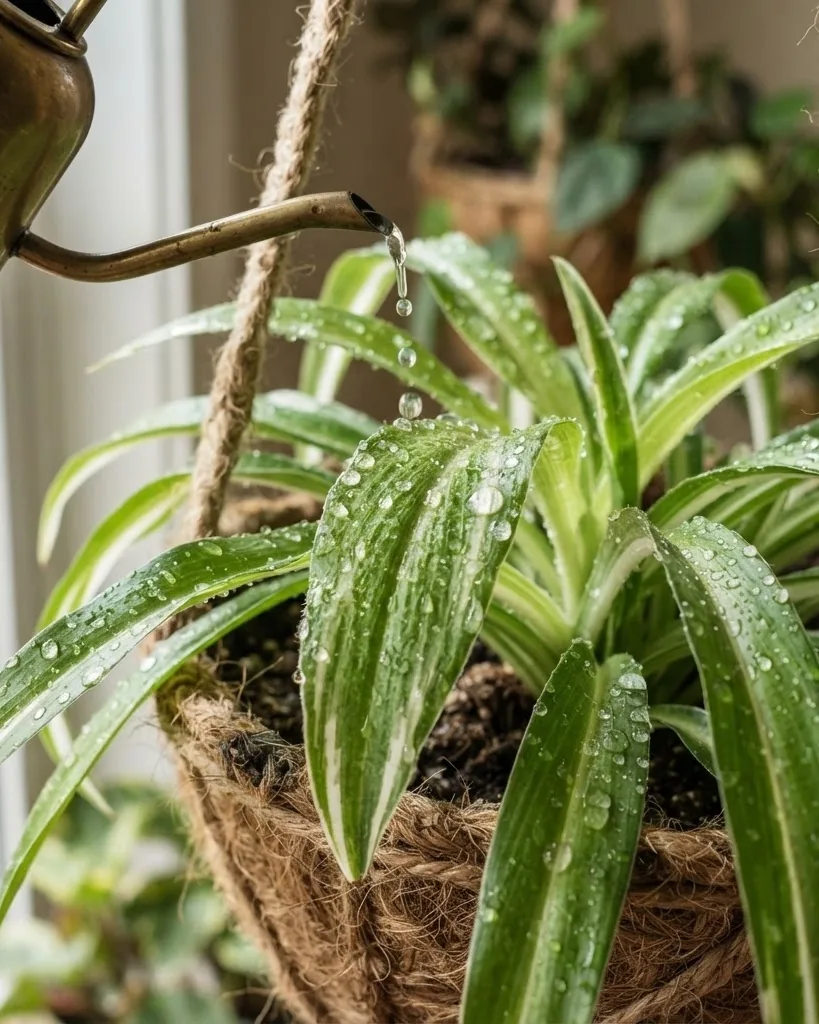
Spider plant in hanging basket displays fail for three boring reasons: the mix dries out before anyone checks it, the hook was never rated for the weight of soaked substrate, and the tap water is quietly burning the leaf tips. None of those are plant problems. They are container problems, hardware problems and water-chemistry problems, and every one of them has a number attached.
Chlorophytum comosum will survive all three. It just will not look good while doing it, and the cascading plantlets that made you want the plant in the first place will never arrive.
Quick answer: a spider plant in hanging basket form does best in a container roughly 2 inches wider than the root ball, hung in bright indirect light, kept above 45 degrees F with an ideal band of 55 to 70 degrees F. Water when the mix is dry 1 inch below the surface, which in a warm room can mean daily. Feed every two weeks at half strength through spring and summer, then stop. Use rainwater or filtered water if your supply is fluoridated, and confirm the hook is rated for the saturated weight, not the dry weight.
Basket size, material and the hook that holds it all up
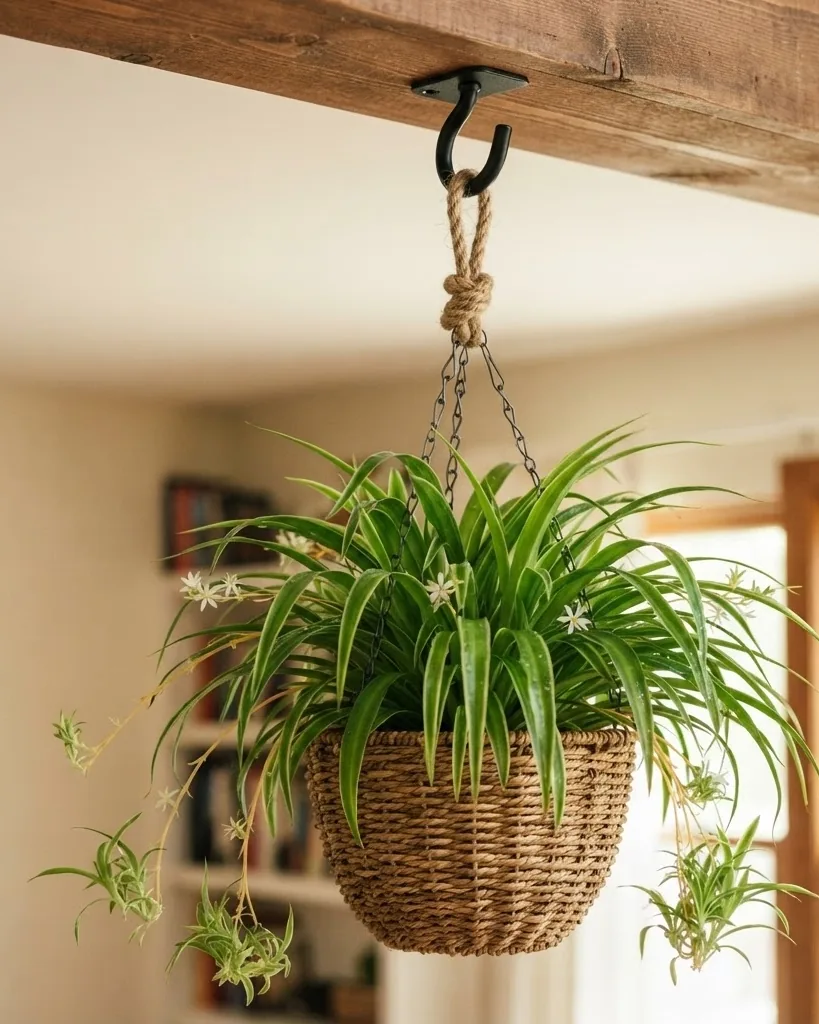
A hanging basket for a spider plant should sit about 2 inches wider than the root ball on every side, and no wider. Oversizing is the most common mistake here, because surplus mix stays soaked long after the roots have drunk their fill. That single sizing rule matters more for this species than for most of the easy houseplants recommended for beginners, because Chlorophytum comosum grows thick tuberous roots that hold their own water. Iowa State University Extension and Outreach frames the hardware side just as bluntly: pick a basket the intended hook can support when the mix is fully hydrated. Clemson Cooperative Extension says the same in factsheet HGIC 1154, published 23 June 1999, warning that a watered basket gets much heavier and needs a strong support system. Plastic holds moisture and weighs little. Wire frames lined with coir or moss look better and dry out fastest.
Rate the hook for wet weight, not shelf weight
The load that matters is the load after watering. Mix that has just taken water to runoff can weigh several times what the same volume weighed dry, and that difference is the whole reason baskets come down in the night.
Work through it in this order:
- Find a ceiling joist with a stud finder and screw into wood wherever you can. Wood is the only support that forgives a mistake.
- If there is no joist, use a toggle bolt rated well above the saturated weight, never a plain plastic drywall plug.
- Choose a swivel hook. A basket that turns lets you rotate the plant for even growth without unhooking it, and even growth is what keeps the cascade symmetrical.
- Consider a wall bracket instead of a ceiling hook in rentals. It transfers load into a stud rather than a ceiling board.
- Hang the empty basket first, then pull down hard on it with both hands before you ever plant it.
Drainage holes, and the pebble layer that does nothing
Drainage holes are non-negotiable. A decorative basket with a sealed base is a bucket, and Missouri Botanical Garden lists root rot as the primary disease risk when this species sits waterlogged.
The pebble layer at the bottom is worse than useless. Clemson states directly that pebbles in the base do not improve drainage. They raise the saturated zone into the root ball and add weight to the hook for no benefit at all.
Hang it where you can reach it
Roughly eye level is the practical ceiling. Higher than that and you cannot check the mix, cannot see the underside of the leaves where scale settles, and cannot unhook the basket one-handed to carry it to the sink.
Indoors, the take-down-to-water routine beats every drip-catching gadget. Carry the basket to a sink or bath, water it until liquid runs out of the base, let it drain for a few minutes, then re-hang it. Clip-on saucer inserts help with condensation drips but they also trap runoff against the base, so empty them.
Where not to hang one
Not over a crib. Not over the head of a sofa or a bed. Not in a walkway where someone tall walks fast in the dark. A basket that falls from ceiling height carries the full saturated weight into whatever is underneath it, and Clemson’s warning about strong support systems exists because that failure mode is common enough to warrant a factsheet line.
Light, temperature and the draft problem
Bright indirect light is the target, and direct sun is the thing to avoid. Missouri Botanical Garden classifies Chlorophytum comosum as a part shade to full shade plant and notes that foliage scalds in direct sun. NC State Extension goes further, describing the species as tolerant of deep shade but intolerant of direct sun. Temperature is where the published numbers get useful. Missouri Botanical Garden gives a floor of 45 degrees F with an ideal band of 55 to 70 degrees F. The Royal Horticultural Society, working in Celsius, specifies a minimum of about 10 degrees C and frost-free conditions. Those two thresholds agree closely enough that you can treat 45 degrees F as the point where damage starts and 55 to 70 degrees F as the range where the plant actually grows rather than merely persists.
A hanging basket sits in the worst part of any room for air movement. Heat rises, so a basket hung near the ceiling in winter sits in the driest, warmest column of air in the house.
Three placements to rule out:
- Directly above or beside a forced-air heating vent, where the mix dries in hours and leaf tips crisp.
- In the path of an air conditioner, which combines cold and desiccation.
- Against a single-glazed window in winter, where night temperatures at the glass can slide below the 45 degrees F floor even when the room reads comfortable.
Variegation responds to light. Push a striped cultivar into a genuinely dark corner and the white markings fade toward green as the plant tries to recover photosynthetic area. Push it into a south-facing window and the same tissue scalds first, because pale stripes carry less pigment to absorb the excess. The narrow band between those two failures is exactly what people mean by bright indirect light, and a basket hung a few feet back from a bright window usually sits in it.
Potting mix and lining a wire basket
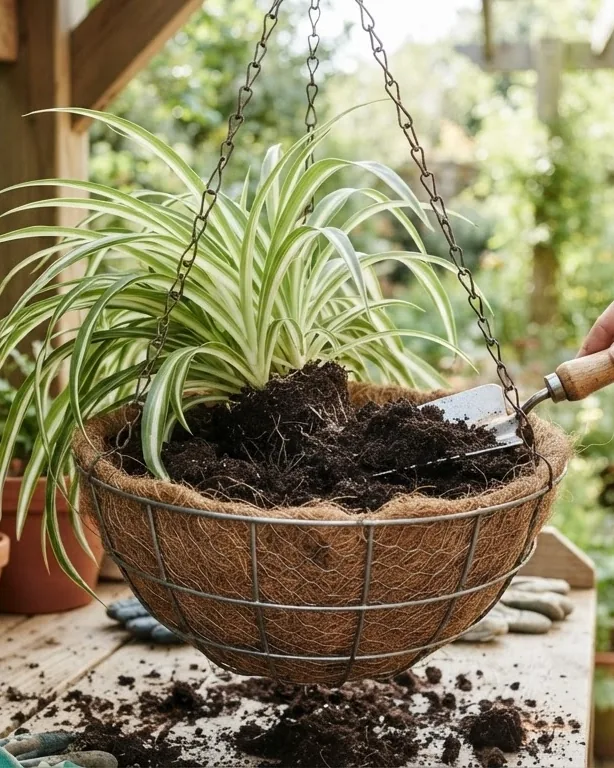
Use a free-draining soilless mix, never garden soil, which compacts and adds dead weight to the hook. A workable blend is 2 parts potting soil to 1 part perlite to 1 part coco coir. For wire baskets, Clemson Cooperative Extension gives precise construction figures: make the moss lining 1 inch thick, extend it up 4 inches, then fill and plant in 4-to-6-inch layers rather than dumping the mix in all at once. Layered planting lets you set crowns through the sides of the liner. University of Illinois Extension notes that wire baskets lose a large amount of moisture through the sides as well as the base, and that lining the inside of the moss with punctured plastic sheeting cuts that loss substantially.
Watering a spider plant in hanging basket without drowning it
Baskets dry faster than any other container because they are exposed on the bottom as well as on every side. Colorado State University Extension recommends checking them once or twice a day for exactly that reason. Clemson gives the trigger point: water when the mix is dry 1 inch below the surface. Iowa State University Extension and Outreach warns that on hot, sunny days a basket may need water once a day, and West Virginia University Extension pushes that to daily or twice daily during hot, dry, sunny spells. Those three sources describe the same physical situation from three campuses. A hanging container has more surface area per unit of soil volume than anything else in the house, sits in warmer air than a plant on the floor, and holds a root system that fills the pot within a season.
Check with a finger, not a schedule. Push it into the mix to the first knuckle. If it comes out clean and the surface crumbles, water. If mix sticks to your skin, wait.
Rehydrating a root ball that has gone hydrophobic
Once a peat-based mix dries out completely it shrinks away from the pot wall. Water then runs down the gap and straight out of the drainage holes, and the root ball in the middle stays bone dry while the runoff convinces you the job is done.
Iowa State University Extension and Outreach gives the fix and the limit in the same breath: submerge the whole basket in a tub of water for 1 to 2 hours, and no longer than 2 hours, because beyond that you start inviting root rot. Set a timer. The 2-hour ceiling is the part people skip.
Water chemistry is why the tips go brown
NC State Extension states plainly that chlorine and fluoride in tap water cause leaf-tip burn in this species. The US Centers for Disease Control and Prevention sets the recommended fluoride concentration in community drinking water at 0.7 milligrams per litre, which means a fluoridated supply delivers a small, steady dose every single time you water.
Michigan State University Extension explains why spider plant sits near the top of the sensitivity list: fluoride-sensitive species are largely monocots, and Chlorophytum comosum is one. The same source flags two other fluoride routes that have nothing to do with your faucet:
- Single superphosphate fertilisers, which carry fluoride as a contaminant.
- Perlite, which contributes some fluoride to the mix.
Rainwater is the cheapest fix if you have a way to collect it. Distilled or filtered water works. Letting tap water stand overnight drives off chlorine but does nothing whatsoever to fluoride, which does not evaporate.
Winter
Cut back sharply. Growth slows, evaporation slows, and the same watering rhythm that kept the basket alive in July will rot it in January. The 1-inch dry-down test still applies; it simply takes far longer to reach.
Feeding without switching off the plantlets
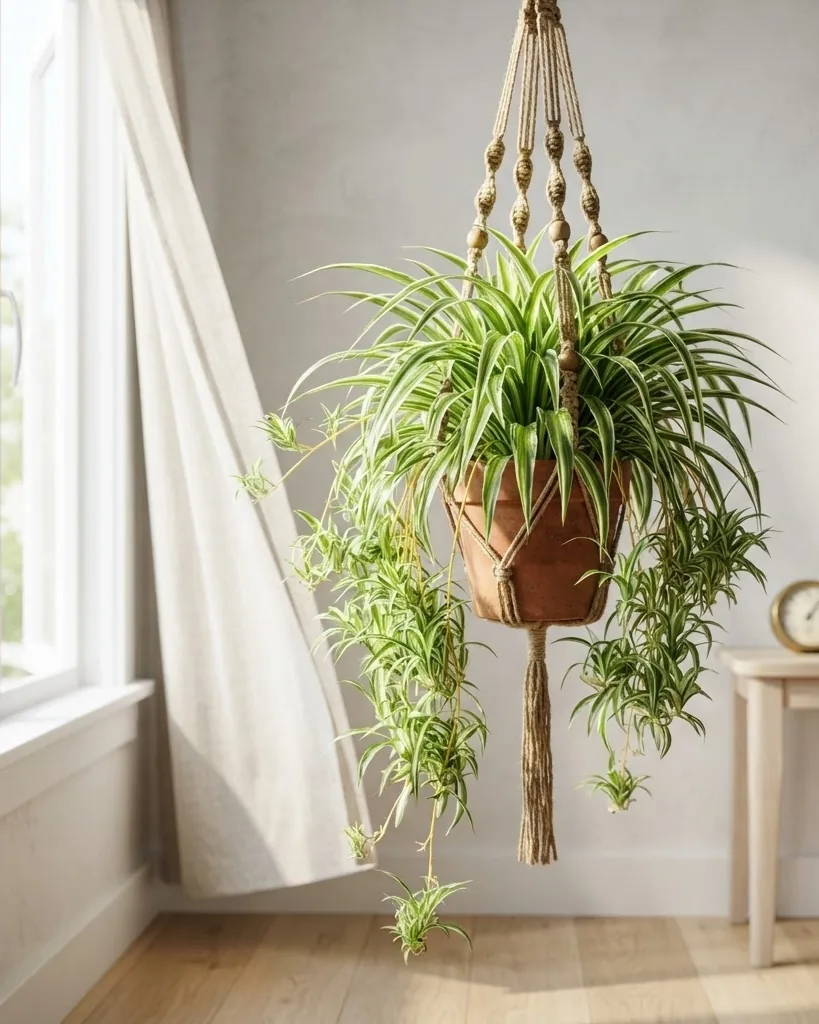
Frequent watering leaches nutrients out of a basket faster than out of a pot standing on a saucer, so baskets do need feeding. Clemson Cooperative Extension specifies a complete liquid fertiliser diluted to half strength, applied every two weeks from spring through summer. Half strength, not full. NC State Extension records the counter-intuitive consequence of ignoring that: over-fertilising reduces plantlet formation. A heavily fed spider plant produces lush foliage and no babies, which is the opposite of what anyone hangs one for.
Salt accumulation is the other half of the feeding question. Fertiliser residues and dissolved minerals concentrate in the mix as water evaporates, and Missouri Botanical Garden lists excess salts among the causes of brown leaf tips.
Leach the basket periodically. Take it down, run water slowly through the mix until several times the pot volume has passed out of the drainage holes, and let it drain fully before re-hanging. Do this at the sink, not in place, unless you enjoy mopping.
Stop feeding entirely from autumn to late winter. The plant is not building tissue, and unused fertiliser salts simply add to the load the roots are already sitting in.
Which cultivar actually hangs well
Not every Chlorophytum makes plantlets, and that distinction decides whether you get a cascade or a static clump. ‘Vittatum’ carries a white central stripe, ‘Variegatum’ carries white margins, and ‘Bonnie’ is a compact whole-plant mutation of ‘Variegatum’ that reaches about 8 in tall and 15 in wide, is protected by plant patent PP13935, and has leaf tips prone to browning. Solid green forms tolerate dim rooms best. Chlorophytum capense ‘Variegatum’ and Chlorophytum orchidastrum ‘Green Orange’ are handsome plants that do not produce pups, so keep them in floor pots.
Why your basket makes no babies
Plantlet production is a photoperiod response, not a fertility problem. Missouri Botanical Garden states that plantlets form only when the plant receives short days and long, uninterrupted nights for at least three weeks. NC State Extension quantifies the same trigger as less than 12 hours of light per day. The word doing the work in the first version is uninterrupted. A single lamp switched on in that room for twenty minutes at 10 pm resets the dark period, and three weeks of near-misses produce nothing.
Run through the checklist before assuming the plant is defective:
- Age. A young division has to build a substantial crown before it invests in stolons.
- Night light. Move the basket out of any room used after dark in autumn, or shield it.
- Feed rate. NC State Extension links over-fertilising directly to reduced plantlet formation.
- Cultivar. Confirm you are growing Chlorophytum comosum and not one of the non-pupping species.
Rooting the pups you get
Three methods work, and they suit different levels of patience. Cut a plantlet with a visible root nub and stand it in water until roots reach an inch or so, then pot it. Or set it straight into damp mix and keep the mix from drying. Or peg the plantlet down onto a small pot of mix while it is still attached to the mother plant, which is the highest-success route because the stolon keeps feeding it until it establishes.
Dividing before the pot splits
The Royal Horticultural Society recommends repotting or dividing every 2 to 3 years. Miss that window and the tuberous roots will physically deform a thin plastic basket, sometimes cracking it while it hangs. Slide the root ball out, cut it into sections with a clean knife, and replant one section into the same basket with fresh mix.
Brown tips, rot and pests, in diagnostic order
Brown leaf tips are the number one complaint with this plant, and they have four documented causes. Missouri Botanical Garden lists them as too little water, low humidity, excess salts and excess fluoride. Work through them in the order that costs you least to test. Water first, because the fix is free and immediate. Salts second, since leaching takes twenty minutes at a sink. Water chemistry third, because switching to rainwater or filtered water takes a week to show results. Humidity last, since it is the hardest to change and the least likely single cause in a normal room. Missouri Botanical Garden separately identifies root rot as the disease to watch when the basket stays waterlogged, alongside whiteflies, spider mites, scales and aphids as the recurring pests.
The diagnostic short version:
- Tips brown, mix bone dry, leaves limp: underwatering. Bottom-soak for 1 to 2 hours, maximum 2 hours.
- Tips brown, mix consistently damp, base of leaves soft or yellowing: root rot. Unpot and inspect.
- Tips brown, white crust on the mix surface or pot rim: salt build-up. Leach.
- Tips brown, everything else normal, fluoridated municipal supply at 0.7 milligrams per litre: water chemistry. Switch sources.
- Whole leaf sections bleached or papery rather than tip-browned: sun scald. Move the basket back from the glass.
Note the cultivar caveat before you blame yourself. Missouri Botanical Garden records that ‘Bonnie’ has leaf tips prone to browning as a characteristic of the plant, so a compact curly-leaved specimen with tidy brown points may simply be behaving as ‘Bonnie’ behaves.
Pests on a plant you cannot reach
Height hides infestations. Scale and mealybugs colonise the leaf undersides and the crown, both of which are invisible from below. Unhook the basket monthly, set it on a table, and look into it. Spider mites announce themselves with fine webbing in the leaf axils and thrive in exactly the warm dry air a ceiling-hung basket sits in.
Treat by taking the basket to a shower and rinsing thoroughly, repeating weekly until the population collapses. The same escalating-symptom logic applies here as in a troubleshooting guide for dying pansies: identify the agent before reaching for a product, because half of what looks like pest damage is a watering fault.
Pets, air-purifying claims, and what the research actually says
The ASPCA Animal Poison Control Center classifies Chlorophytum comosum as non-toxic to dogs, cats and horses, with no toxic principle listed. That is a real safety advantage over most trailing houseplants, and it is the correct answer to give a worried cat owner. It is also frequently overstated. Non-toxic means the plant contains no compound the ASPCA identifies as poisonous; it does not mean a cat can eat a bowl of it without consequence, because ingesting quantities of any plant material can provoke vomiting. The practical wrinkle specific to hanging baskets is that dangling stolons and swinging plantlets are precisely the kind of moving target cats hunt, so this species attracts feline attention more than a static plant on a shelf does.
Placement solves most of it. Hang the basket where there is no launch pad within jumping range, which usually means away from bookcases, the back of the sofa and windowsills. If the plantlets still trail into cat territory, trim the stolons back rather than surrendering the plant.
The air-purification claim, with both papers on the table
Every listing for this plant repeats that it cleans indoor air. The claim traces to a single document: Wolverton, Johnson and Bounds, Interior Landscape Plants for Indoor Air Pollution Abatement, NASA technical memorandum NASA-TM-101766, dated 15 September 1989. That work was conducted in sealed chambers, and it is genuine research. The problem is the leap from sealed chamber to living room.
Cummings and Waring published a reanalysis in 2020 in the Journal of Exposure Science and Environmental Epidemiology, pooling 12 studies and 196 experimental results. They found a median clean air delivery rate of 0.023 cubic metres per hour per plant, which implies somewhere between 10 and 1000 plants per square metre of floor space to match the air exchange an ordinary building already achieves through ventilation. The American Lung Association restates the same finding in consumer terms: roughly 680 plants in a 1,500 sq ft home.
Grow the plant because it looks good hanging in a window. The air quality in your house is set by ventilation, not by foliage.
Summering the basket outdoors
Chlorophytum comosum is native to Southern Africa. Outside naturally warm regions, the basket is best treated as a summer visitor only. The University of North Florida Botanical Garden reports plants surviving winter temperatures in the upper teens degrees F when sited in sheltered, shady, well-drained positions, and notes that outdoors the plant spreads as groundcover by rooting its own plantlets where they touch soil. Move the basket into full shade outside, never sun, and bring it back in well before night temperatures approach the 45 degrees F floor.
Frequently asked questions
How often should I water a spider plant in hanging basket?
Check it once or twice a day, which is what Colorado State University Extension recommends for baskets generally, and water when the mix is dry 1 inch below the surface. In hot, sunny weather that can mean daily watering, and West Virginia University Extension notes containers may need it twice a day. Winter watering drops sharply.
Why does my plant produce no babies?
Plantlets need short days and long, uninterrupted nights for at least three weeks, and NC State Extension puts the threshold at less than 12 hours of light per day. A lamp switched on at night in that room will block it. Over-fertilising also suppresses plantlet formation, so ease off the feed.
Are spider plants safe around cats?
The ASPCA Animal Poison Control Center lists Chlorophytum comosum as non-toxic to dogs, cats and horses. Non-toxic does not mean inert: chewing any plant material can trigger vomiting. Dangling stolons are exactly what draws a cat to a hanging planter, so hang it clear of furniture the cat uses to launch.
Why are the leaf tips brown?
Missouri Botanical Garden lists four causes: too little water, low humidity, excess salts and excess fluoride. Municipal water is fluoridated to 0.7 milligrams per litre in the United States, and Michigan State University Extension flags spider plant among the fluoride-sensitive monocots. Switch to rainwater or filtered water before blaming anything else.
Can the basket live outdoors year round?
The University of North Florida Botanical Garden reports plants surviving winter temperatures in the upper teens degrees F in sheltered, shady, well-drained spots. Elsewhere, treat it the way you would treat easy annual flowers for a backyard garden and move it indoors before temperatures reach 45 degrees F.
Do spider plants clean indoor air?
Not meaningfully. The 2020 reanalysis in the Journal of Exposure Science and Environmental Epidemiology pooled 12 studies and 196 experimental results and found a median clean air delivery rate of 0.023 cubic metres per hour per plant. The American Lung Association restates that as roughly 680 plants in a 1,500 sq ft home.