The whole trick to how to prune hydrangea is one question: does your shrub bloom on old wood or new wood? Bigleaf and oakleaf types set next summer’s buds the year before, so you prune them right after they flower and only lightly. Panicle and smooth types flower on fresh spring growth, so you cut those back in late winter and can go hard. Get that single fact right and everything else, the timing, the tools, how much to remove, falls neatly into place. Guess wrong and you snip off a year of blooms in one afternoon.
The One Rule That Decides Everything
Most sad, flower-free hydrangeas are not sick. They were pruned at the wrong time. A shrub either carries its flower buds through winter on last year’s stems (old wood) or grows brand-new stems each spring that flower the same season (new wood). That difference is the entire game.
Old-wood bloomers form their buds in late summer, weeks after they finish flowering. Those buds ride out the cold on bare stems. If you cut those stems in autumn, winter, or spring, you throw the buds in the compost and wonder why nothing blooms. New-wood bloomers do not care. They build flower stems from scratch after you cut, so a hard trim actually pushes stronger blooms.
The Royal Horticultural Society, whose RHS pruning advice I check every spring, sums it up plainly: panicle and smooth hydrangeas flower more freely when cut back yearly to a low framework, while bigleaf and oakleaf need a gentler hand and a later date. So before you touch a single stem, name your plant. I keep a note on my phone for each shrub in my garden so I never have to guess in March.
Know Which Hydrangea You Have (The 4 Main Types)
There are four types you will meet in most gardens, and each one falls cleanly into the old-wood or new-wood camp. Learning to tell them apart takes ten minutes and saves you a whole season of regret.
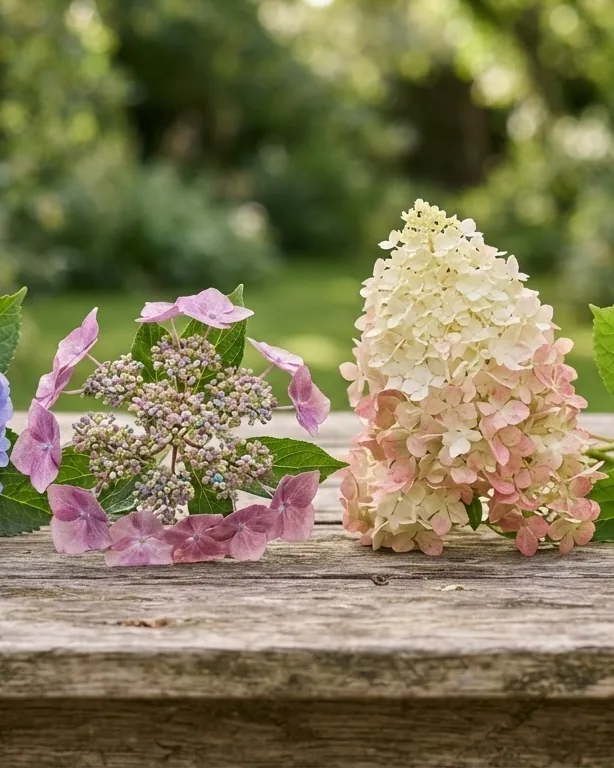
Bigleaf hydrangea (Hydrangea macrophylla) is the classic, with big rounded mophead balls or flat lacecap rings of bloom, often blue or pink depending on soil. Oakleaf hydrangea (Hydrangea quercifolia) has cone-shaped white flowers and, as the name says, leaves shaped like oak leaves that turn deep red in fall. Both bloom on old wood.
Panicle hydrangea (Hydrangea paniculata) carries long, pointed cone flowers and is the toughest of the group; Limelight is a common one. Smooth hydrangea (Hydrangea arborescens) gives you those huge round white heads, with Annabelle the best-known variety. Both bloom on new wood, so they get the winter trim.
| Hydrangea type | Blooms on | When to prune | How hard |
|---|---|---|---|
| Bigleaf (macrophylla) | Old wood | Right after flowering, in summer | Light: deadhead, thin weak stems |
| Oakleaf (quercifolia) | Old wood | Just after flowers fade | Very light: remove dead or broken only |
| Panicle (paniculata) | New wood | Late winter or early spring | Hard: back to a low framework |
| Smooth (arborescens, Annabelle) | New wood | Late winter or early spring | Hard: down to about 30 cm |
The Old Farmer’s Almanac keeps a handy Almanac pruning chart that matches this split, and it is worth a bookmark if you grow more than one kind. When you are unsure, watch the plant for a full year first. A shrub that flowers in early summer on stems that were already there is almost always an old-wood type; one that blooms later on soft new shoots is new wood.
The Tools You Need (And Why Clean Blades Matter)
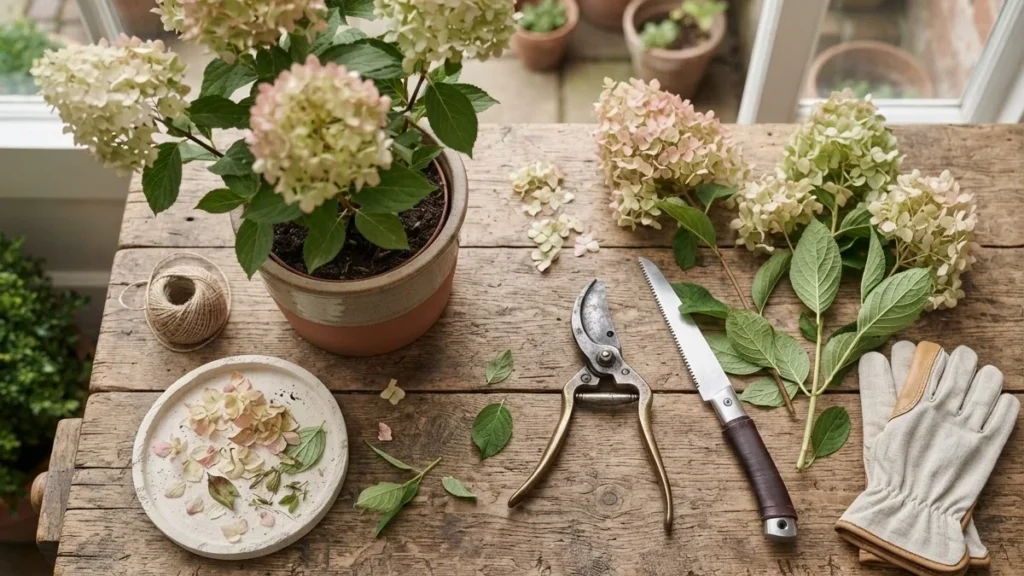
You do not need much. A sharp pair of bypass secateurs handles nearly every hydrangea cut. Bypass blades slice past each other like scissors and leave a clean wound; anvil blades crush the stem against a flat edge and bruise it, which invites rot. For thick, woody old stems near the base, add a pair of loppers or a small pruning saw so you are not straining the secateurs.
Hygiene matters more than gardeners expect. A clean cut heals fast and shuts the door on infection. Wipe or soak blades with roughly 70% isopropyl alcohol, or a diluted household bleach solution around 10%, and do it between each shrub so you are not carrying disease from one plant to the next. A quick wipe takes under 1 min; a proper soak of 5 to 10 min is smart if you spotted any dieback or mildew.
Keep blades sharp, too. A dull edge tears rather than cuts, and a ragged wound is slow to close. When you make a cut, angle it slightly and use the tips of the secateurs, because hydrangea buds sit close to the stem and knock off easily. I learned that the messy way, shearing off three fat buds with one careless snip.
- Bypass secateurs for stems up to about pencil thickness.
- Loppers or a folding pruning saw for old woody canes at the base.
- 70% alcohol or 10% bleach to disinfect between plants.
- Clean rag, and gloves if the stems are stiff and scratchy.
How to Prune Old-Wood Types: Bigleaf and Oakleaf
Old-wood hydrangeas ask for restraint. The golden window is right after they finish flowering, usually mid to late summer, and no later. Once the plant starts setting next year’s buds, your window closes. Cut in autumn or spring and you are removing the very stems that were about to bloom.
For bigleaf types, start by deadheading: snip each faded flower back to the first strong pair of buds below the bloom. Then look at the base. Each year you can remove up to 33% of the oldest, thickest stems, cutting them down to ground level to renew the shrub and let light into the middle. Leave the healthy young stems alone, since those carry next summer’s flowers.
Oakleaf hydrangeas need even less. They are slow, structural shrubs, and most years you only remove dead, damaged, or crossing branches. If a plant has outgrown its spot, shape it lightly in summer after the flowers fade, never in spring. The RHS advice for these old-wood shrubs is consistent: prune soon after flowering and keep it gentle, because hard cuts cost you the show.
One habit that helps: step back every few cuts and look at the whole shrub. Pruning is as much about shape and airflow as it is about flowers. An open center dries faster after rain, which means less mildew on the leaves through a humid summer.
How to Prune New-Wood Types: Panicle and Smooth
Now the fun part, because here you can be bold. Panicle and smooth hydrangeas bloom on growth they make in the current season, so late winter to early spring is your moment, just before the buds swell and push. Cutting now wakes the plant up and channels its strength into fewer, stronger, flower-bearing stems.
For smooth types like Annabelle, cut the whole plant back hard, down to about 30 cm from the ground. Do not shear it all the way to the crown, though; stems that start too low grow thin and floppy and then face-plant into the mud after the first heavy rain. Leaving a short, sturdy framework gives the new canes something firm to build on, so the big heads stay upright.
For panicle types, the RHS suggests cutting last year’s stems back to a pair of healthy buds on a permanent framework of branches. Hard-prune to the lowest strong buds and you get fewer but larger flower cones on stout, upright stems; leave the framework a little taller, and you get more heads at a slightly smaller size. Either way, remove any thin, weak, or crossing shoots first so plant strength goes where you want it.
This is also the season for renewal on an old, tired panicle. If the shrub has become a tangle of twiggy growth, choose five to seven of the best main stems, cut each back to the framework, and clear the rest. It looks brutal in March and glorious in August.
Deadheading Is Not the Same as Pruning
Gardeners mix these up, and it costs them blooms. Deadheading just removes spent flowerheads; pruning removes stems and reshapes the plant. On a mophead bigleaf, resist the urge to cut off the faded brown heads in autumn. Those tired blooms are frost armor, shielding the tender buds just below them when temperatures drop below 0 degrees C.
Wait until late spring, when worst frosts have passed, then cut each old head back to the first fat pair of buds. On a lacecap, which is a bit hardier, you can tidy the faded heads earlier, cutting back to the second pair of leaves below the bloom, but do it no later than August so new growth has time to firm up before winter.
Smooth and panicle types are simpler here. Their old flowerheads look lovely dusted with frost and hold snow prettily, so many gardeners leave them for winter interest and simply take them off during the late-winter hard prune. There is no bud to protect on new-wood stems, so the timing is relaxed.
USDA Hardiness Zones and How Climate Shifts Your Timing
Most garden hydrangeas are comfortable across USDA hardiness zones 3 to 9, but the type matters. Smooth hydrangeas like Annabelle are very cold-tough, roughly zones 3 to 8, which is why they thrive where a late frost near -5 degrees C would ruin a bigleaf’s buds. Oakleaf sits a touch warmer, around zones 5 to 9, and panicle is famously hardy well into the cold end of the scale.
Your zone nudges your calendar. In a cold zone, spring arrives late, so the late-winter prune on new-wood types might land in March or April rather than February. In a mild zone, growth starts sooner, so watch buds, not dates. The USDA zone map tells you your average low, and that number is a better guide than any fixed week on the calendar.
Bigleaf gardeners in cold zones have the hardest time, because a warm spell can coax out buds that a following frost of -3 degrees C then kills. If that is you, choosing a reblooming variety that flowers on both old and new wood gives you a safety net, since even a lost old-wood crop leaves a second chance on the summer’s new growth.
When You Should Not Prune at All
Sometimes the best cut is no cut. A newly planted hydrangea should be left alone for its first 12 months, and ideally through one to two full growing seasons, so it can put energy into roots instead of recovering from wounds. Beyond removing anything clearly dead or broken, let a young shrub settle before you start shaping it.
Never hard-prune an old-wood bigleaf or oakleaf in spring. I know the bare winter stems look untidy and you will be tempted, but every one you shorten is a flower you cancel. If you must reduce the size of an old-wood shrub, do it in summer right after flowering, and even then take no more than a third.
Skip heavy autumn cuts across the board. On old-wood types you expose buds to winter; on new-wood types you gain nothing, since fresh stems and their flowers are months away. Wait the 4 to 5 months until late winter for the paniculata and arborescens trim. And always stop to disinfect if you move to a plant showing spots or wilt, giving the blades a full 24 hours to dry after a bleach soak if you can.
For a wider look at cutting back flowering shrubs at the right moment, our guide to pruning shrubs in summer pairs well with the old-wood timing above, and you can browse more woody-plant care in our shrubs section for companion plants that like the same treatment.
A Simple Step-by-Step for the Cut Itself
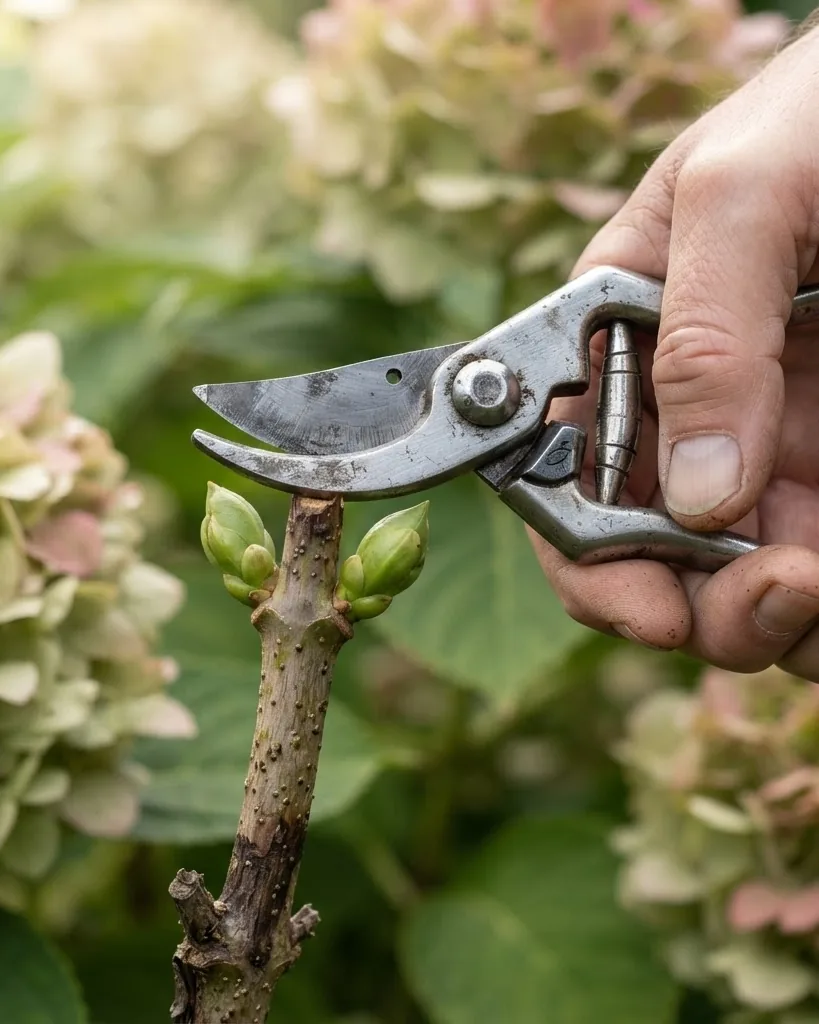
Whatever the type, the mechanics of a good cut stay the same. First, clean your blades. Second, find a healthy pair of buds facing outward from the stem, since the new shoot follows the direction the bud points. Third, cut cleanly just above that pair, angled slightly away so water runs off the wound rather than pooling on it.
Do not leave a long stub above the buds, because a stub dies back and can rot into the healthy wood below. Do not cut so close that you nick the buds either. A finger-width gap is about right. Work from the outside in, removing dead and weak stems first, then step back, judge the shape, and take your renewal cuts at the base.
Collect and bin any diseased trimmings rather than composting them, and give the blades a final wipe before you put them away. That last minute of care means your secateurs are ready and clean the next time a shrub needs you, which, once you know how to prune hydrangea by type, becomes a quick and confident job rather than a nervous one.
Reblooming Varieties: A Safety Net for Cold Gardens
Plant breeders have muddied these clean rules in a helpful way. Reblooming bigleaf hydrangeas, sometimes called remontant, flower on both old wood and new wood in a single season. Endless Summer is a widely grown example. For a gardener in a cold zone where late frost keeps wrecking old-wood buds, this trait is a genuine safety net, since a lost first flush on last year’s stems still leaves a second show on fresh summer growth.
Prune these repeat-flowering shrubs lightly and often rather than hard and once. Deadhead spent blooms through summer to encourage that second wave, and remove weak or dead stems whenever you spot them. Treat a remontant much like a standard bigleaf: gentle cuts, timed close to flowering, with any real thinning done in summer. A hard winter cut still costs you that early old-wood crop, so restraint pays even on a rebloomer.
If reliable flowers in a harsh climate are your goal, lean on the toughest performers. Smooth types such as Annabelle and cold-hardy panicles bloom on new wood no matter what winter throws at their old stems, which makes them close to foolproof where a bigleaf struggles. Matching variety to climate is quietly more important than any pruning trick, and it saves you from fighting your weather every single spring.
Aftercare: What to Do Once You Have Finished
Pruning is only half a job. A shrub you have just cut back is putting energy into fresh shoots, and a little help now pays off in bigger, healthier blooms. Once your cuts are done, spread a generous layer of compost or well-rotted manure around its base, keeping it clear of the crown so stems do not rot. That mulch feeds slowly, holds moisture, and smothers weeds that would otherwise compete for water.
Feeding matters, but go easy. A balanced slow-release fertilizer in early spring supports new growth without pushing it too fast. Resist heavy nitrogen feeds, which coax out lush leaves at the expense of flowers, one of the sneakier reasons a well-pruned shrub still refuses to bloom. Water deeply after a hard cut, especially on smooth types that are about to grow a full canopy from almost nothing, and keep them moist through their first dry spell.
Watch the new shoots as they appear. On a hard-pruned panicle or Annabelle, thin out any weak or crowded stems while they are still soft, so light and air reach the center. Good airflow is your best defense against the powdery mildew that loves damp, congested growth in a humid summer. A few minutes of thinning in May saves a lot of spraying in July.
Mark your pruning dates on a calendar once you know each shrub’s type, and you will never second-guess yourself again. I jot down what I cut and when, plus a quick note on how each plant responded, so every season teaches the next. Over a few years that little log turns a nervous chore into a five-minute routine you actually look forward to.
Common Mistakes That Cost You Blooms
After years of coaching friends through their gardens, I see the same handful of slip-ups again and again. The biggest is pruning by the calendar instead of by the type. A tidy gardener who cuts everything back in autumn will hammer their bigleaf and get a green, flowerless shrub the next year while their panicle shrugs it off. Timing follows the plant, never the tidy urge.
The second mistake is cutting too little on new-wood types. People are nervous with the secateurs and leave a tall, twiggy tangle, so the plant spreads its energy thin and produces many small, floppy heads. Be braver: a hard late-winter cut on a paniculata or arborescens rewards you with fewer, larger, sturdier blooms. Confidence here is a virtue, not a risk.
Third is dirty or dull blades. A crushed, ragged cut is a doorway for disease, and moving from a sick plant to a healthy one on unwiped secateurs can spread trouble across a whole border. Keep that 70% alcohol handy and use it. Fourth, and easy to fix, is removing the faded heads from mopheads too early and losing their frost protection through a cold snap below 0 degrees C. Patience beats neatness every time in a hydrangea bed.
Frequently Asked Questions
Can I prune my hydrangea in autumn to tidy it up for winter?
Better not, for most types. On old-wood bigleaf and oakleaf shrubs, autumn cuts remove the buds that carry next summer’s flowers and strip away the faded heads that protect tender buds through frost. On new-wood panicle and smooth types, an autumn cut gains you nothing and can expose the plant to winter damage. Leave the seed heads on for winter interest and frost cover, then do your real pruning in late winter or in summer after flowering, depending on the type.
My hydrangea has not flowered in two years. What did I do wrong?
The most common cause is pruning an old-wood type at the wrong time, usually a spring cut that removes the buds. Other culprits are a late frost near -3 degrees C that killed exposed buds, too much shade, or a heavy dose of nitrogen fertilizer that pushes leaves over flowers. Identify whether your shrub is old wood or new wood, match your timing to the table above, and hold off pruning entirely for a season to let it rebuild. Nine times out of ten the blooms come back.
How much of the plant can I safely remove in one year?
On old-wood types, take up to 33% of the oldest stems at the base each year, plus deadheading; that renews the shrub without sacrificing the flowering canes. On new-wood types you can be far bolder, cutting the whole plant back to a low framework or down to about 30 cm for smooth types like Annabelle. The plant regrows and flowers on that fresh growth the same season, so a hard late-winter cut is a feature, not a risk.
Do I really need to disinfect my secateurs between plants?
Yes, and it takes almost no effort. Fungal and bacterial diseases spread easily on a dirty blade, so a shrub that looks healthy can pick up trouble from a sick neighbor you pruned a minute earlier. A quick wipe with 70% alcohol between plants, under 1 min each time, is cheap insurance. After cutting anything with visible dieback or mildew, give blades a longer soak of 5 to 10 min, then dry them so they do not rust. Clean, sharp tools also make crisp cuts that heal fast.
What is the single best time to prune, if I only remember one thing?
Remember the wood. If your shrub blooms early in summer on stems that survived winter, it is old wood, so wait and prune lightly right after flowering. If it blooms later on soft new stems, it is new wood, so cut it back hard in late winter before growth starts. That one distinction, old wood after flowering versus new wood in late winter, answers most timing questions and protects next season’s display.