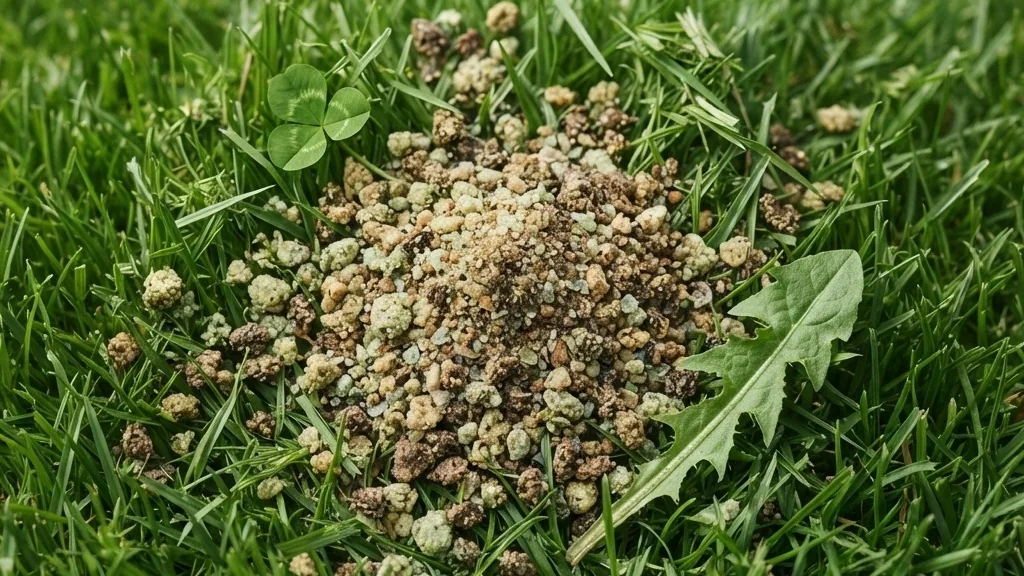
Weed and feed for lawns sells one promise: two chores collapsed into a single pass across the yard. The bag is real, the chemistry works, and plenty of homeowners apply it correctly every April. Trouble starts with what the front panel leaves out. A product that is legal to buy in Maryland on November 20 is illegal for a homeowner to apply that day. A granule that greens up Kentucky bluegrass will thin or kill St. Augustinegrass. And the weed most people are actually chasing is often a grass, which is why identifying crabgrass seedlings before they spread saves an entire season of guessing.
Quick answer: weed and feed for lawns pairs a selective broadleaf herbicide with an N-P-K fertilizer in a single granule or spray. Apply it when broadleaf weeds are actively growing, daytime temperatures sit between 60 and 90 degrees F, the blades are wet, and your grass species appears on the approved list. A 14.29 lb bag of 28-0-3 covering 5,000 sq ft delivers 0.80 lb of actual nitrogen per 1,000 sq ft, so two spring passes plus a separate feeding overshoots most annual budgets. Check your state fertilizer law first. Maryland caps a single application at 0.9 lb N per 1,000 sq ft.
What weed and feed for lawns actually contains
Weed and feed for lawns is one product doing two unrelated jobs: a selective herbicide that kills broadleaf plants, and a fertilizer that pushes grass growth. The herbicide side is normally 2,4-D combined with mecoprop-p, dicamba, MCPA or fluroxypyr, all of them Group 4 synthetic auxins under the Weed Science Society of America classification.
Group 4 chemistry imitates indole-3-acetic acid, the plant hormone that governs cell elongation. Broadleaf tissue answers with disorganized growth and collapses. Grass blades tolerate the same dose, which is the entire basis for the word selective on the front panel. Quinclorac, the one common partner that reaches crabgrass after germination, sits in Group 4 and 29. On the fertilizer side, cool-season bags lean hard on nitrogen, with phosphorus often left out of the guaranteed analysis entirely.
Three formulation types share the shelf, and they do different work:
- Post-emergent. Kills broadleaf weeds already standing. Does nothing to seed still in the soil.
- Pre-emergent. Blocks germinating seed. Does nothing to a dandelion in bloom.
- Combination. Pre-emergent, post-emergent and fertilizer stacked into one granule, usually branded as triple action.
Pick the wrong one and nothing visible happens for six weeks.
Granular product carries a physical requirement that liquids do not. The particle has to adhere to a weed leaf long enough to deliver its dose. Spread it on dry blades at eleven in the morning and it bounces to the soil, feeds the turf, and leaves the weeds untouched. Dew or a light pre-watering solves that.
Two weed classes stay standing no matter how carefully you spread. Grassy weeds such as crabgrass and foxtail shrug off a broadleaf-only blend, since they are grasses. Sedges, yellow nutsedge above all, resist every active ingredient in the standard mix.
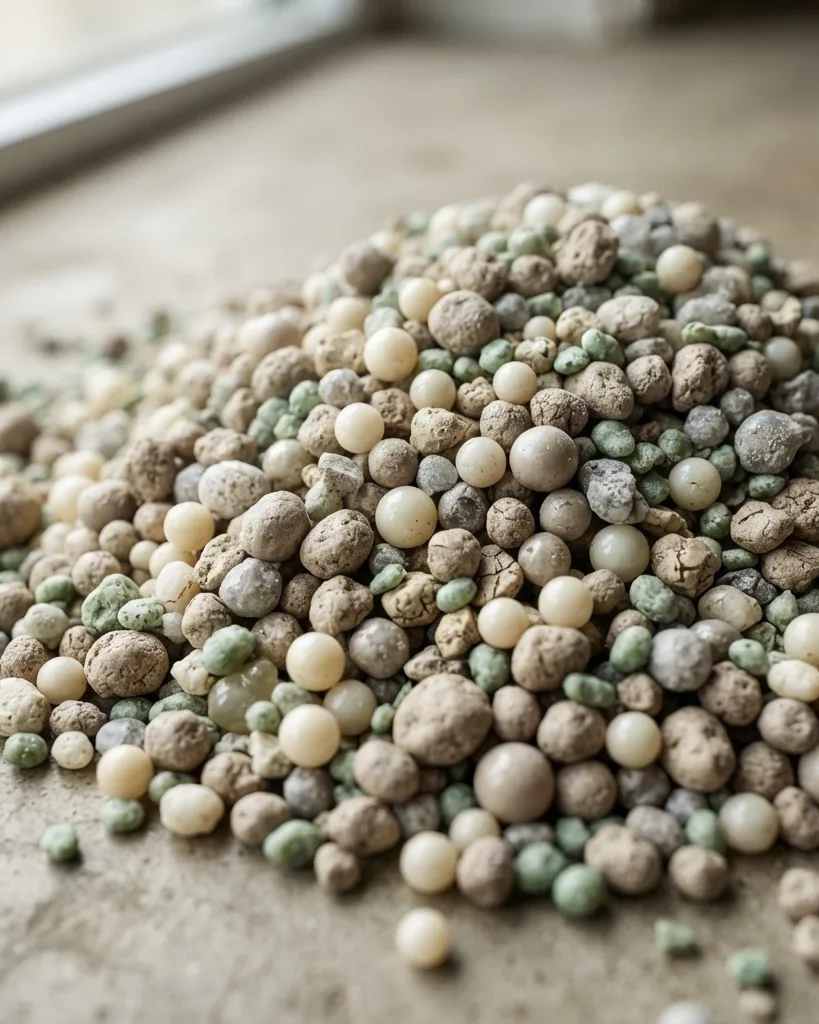
The grass type kill list that ruins lawns every spring
Grass species decides whether the bag feeds your lawn or destroys it, and the outcome is binary. Standard 2,4-D, mecoprop and dicamba blends are formulated for cool-season turf. On several warm-season species, the identical granule causes thinning, stunting or death within weeks.
The Scotts Turf Builder Weed and Feed label bars application to St. Augustinegrass, including the Floratam cultivar, and to dichondra, lippia, carpetgrass and bentgrass. Centipedegrass and bahiagrass belong on the same caution list for most broadleaf combination products. Homeowners across Florida and the Gulf Coast are the people most likely to buy something their lawn cannot survive, because a national chain stocks the same national item in every climate zone it serves.
Species that generally tolerate the standard blend
- Kentucky bluegrass
- Perennial ryegrass
- Fine fescue
- Tall fescue
- Zoysia, but only during active growth, never dormant or in spring transition
Zoysia deserves its own line. Several labels list it as tolerant, and that tolerance evaporates when the turf is brown and translocating nothing. A product applied to dormant zoysia delivers herbicide to weeds that are awake and fertilizer to grass that cannot use it.
The Southern lawn workaround
Warm-season lawns are not locked out of the category. Atrazine-based combination products, Scotts Bonus S among them, are the labeled route for St. Augustinegrass and centipedegrass. Atrazine is different chemistry with its own label constraints, so the registration number on the front of that bag governs what you may legally do with it.
The other path is simpler and works everywhere: fertilize with a straight fertilizer, then treat the weeds separately with a product labeled for your species. You lose the convenience. You gain the ability to hit each target on its own schedule, which is the whole argument against the combination bag in the first place.
One test before checkout. Find your grass species on the label, in the tolerant list or the prohibited list. If it appears in neither, the manufacturer has not tested it, and your lawn is the trial.
Read the active ingredient panel, not the front of the bag
The guaranteed analysis panel describes fertilizer. The active ingredient panel, printed small on the back, describes the herbicide and its concentration. Those percentages swing by more than a factor of ten across products that all get called weed killer at the register.
Scotts Turf Builder Weed and Feed lists 2,4-D at 1.220 percent and dicamba at 0.081 percent, with other ingredients at 98.699 percent. A liquid concentrate operates on another scale entirely. Southern Ag Lawn Weed Killer with Trimec carries mecoprop at 5.30 percent, 2,4-D at 3.05 percent and dicamba at 1.29 percent. Fertilome Weed Free Zone, EPA Registration Number 2217-855-7401, runs 2,4-D at 10.49 percent, mecoprop-p at 2.6 percent, dicamba at 0.67 percent and carfentrazone-ethyl at 0.54 percent.
A granule is mostly fertilizer by weight, so it carries roughly an order of magnitude less herbicide than a concentrate. That is precisely why coverage errors punish you harder with granules: the margin between an effective dose and no dose is thin, and it is set by how evenly the particles land.
Each component earns its slot:
- 2,4-D: the broad-spectrum backbone of nearly every blend.
- Mecoprop, also sold as MCPP: chickweed and clover.
- Dicamba: ground ivy and the stubborn creepers.
- Triclopyr: clover, oxalis and woody seedlings.
- Carfentrazone-ethyl: speed, for visible burndown in days rather than weeks.
- Quinclorac: crabgrass after it has germinated.
Every one of those products has a legally binding label archived by the United States Environmental Protection Agency. Pull it by registration number from the EPA Pesticide Product Label System instead of trusting a retail listing, which drifts from the registered document as formulations change.
The nitrogen arithmetic printed on no bag
A 14.29 lb bag of 28-0-3 covering 5,000 sq ft applies 0.80 lb of actual nitrogen per 1,000 sq ft. That number decides whether the product fits your season or blows through it, and no front panel prints it.
Two steps get you there from any bag. Divide bag weight by coverage in thousands of square feet: 14.29 divided by 5.0 gives 2.86 lb of product per 1,000 sq ft. Multiply by the nitrogen percentage: 2.86 times 0.28 gives 0.80 lb of actual nitrogen per 1,000 sq ft. Turf specialists at Purdue University set the ceiling for any single application at 1.0 lb N per 1,000 sq ft, so one correct pass clears it with room to spare.
| Bag or rule | Coverage | Product per 1,000 sq ft | Actual N per 1,000 sq ft |
|---|---|---|---|
| Scotts Turf Builder Weed and Feed, 14.29 lb, 28-0-3 | 5,000 sq ft | 2.86 lb | 0.80 lb |
| Same product, 42.87 lb bag | 15,000 sq ft | 2.86 lb | 0.80 lb |
| Purdue single-application ceiling | any lawn | varies | 1.00 lb maximum |
| Maryland statutory cap | any lawn | varies | 0.90 lb maximum |
Where one bag fits an annual budget
Purdue Extension publication PPP-155 puts cool-season lawns at 1 to 3 lb of actual N per 1,000 sq ft per year under low maintenance, rising to 3.5 to 4 lb for a well maintained stand. UW-Madison Extension in Dane County trims that by exposure: 1 lb N per 1,000 sq ft on sun-grown turf, and only 0.5 lb on shade-grown turf, with 25 to 50 percent of the nitrogen in slow-release form.
Now do the subtraction. Returning clippings instead of bagging them supplies roughly 1.0 lb N per 1,000 sq ft per year on its own. A shaded lawn at 0.5 lb of annual demand is already oversupplied by mulched clippings alone, and a single 0.80 lb application of weed and feed on top of that is fertilizer you paid for and the storm drain receives.
Purdue also advises against fertilizing more often than monthly at the 1.0 lb rate. Two combination applications thirty days apart, in a lawn that also gets a fall feeding, lands near the top of the low-maintenance range before you have added anything else.
Spreader settings and the federal ceiling
Scotts publishes 3 1/2 for its rotary spreaders and 5 for drop spreaders on this product. Both assume the spreader is calibrated and walked at a steady pace. Run a test pass on a measured strip before committing to the whole yard, because a doubled overlap at the lawn edge is the single most common cause of striping.
Federal limits sit above all of it. The label for EPA Registration Number 2217-884, a Trimec-type granular, allows a maximum broadcast rate of 4.0 lb of product per 1,000 sq ft per application, two broadcast applications per year, at least 30 days apart, and 8.0 lb per 1,000 sq ft as a seasonal maximum. At the 4.0 lb rate, that delivers 1.28 lb of 2,4-D acid equivalent per acre. The full document is public in the EPA archived product label, and reading it takes less time than a second pass across the lawn.
Liquid equivalents run parallel ceilings. Trimec Classic, EPA Registration Number 2217-543, and Triplet SF, EPA Registration Number 228-312, both cap at 4.0 pints per acre per application, 8 to 10 pints per acre annually, two applications per year, 30 days apart. Rotating between those brands rotates nothing chemically, since both stack Group 4 auxins. Consult Purdue turf fertilizer recommendations before deciding a second pass is warranted.
Timing: the six to ten week gap between the two windows
The herbicide window and the fertilizer window rarely coincide, and the distance between them is measurable in weeks. UF/IFAS puts the ideal North Florida pre-emergent date at March 1 and the first recommended fertilizer application at April 15, a gap of roughly six weeks in the same landscape.
Oklahoma State Extension opens it wider still. Pre-emergent herbicide performs best there before late February, while bermudagrass should not be fertilized until about May 1, leaving nine to ten weeks between the two correct dates. University of Illinois Extension supplies the biology behind the herbicide half: crabgrass germinates once soil temperature holds above 55 to 60 degrees F for seven to ten consecutive days, and a pre-emergent barrier needs to be in place one to two weeks before that.
Post-emergent timing runs on air temperature instead. Daytime highs should sit consistently between 60 and 90 degrees F, the weeds should be actively growing, and the blades should be wet from dew or a light watering.
Then the two irrigation rules collide. A granular post-emergent label says do not water for 24 hours after application, and do not apply if rain is expected within 24 hours. A pre-emergent needs watering in to reach the soil where germinating seed sits. Buy a combination bag and you have bought that contradiction, resolved by whichever compromise the manufacturer chose.
Heat sets the outer bound. UF/IFAS reports that pre-emergent herbicides in these combination products can injure turf when temperatures exceed 90 degrees F for three consecutive days, which rules out a July rescue application across much of the country. Details on placement and rate are covered by UF/IFAS guidance on right fertilizer, right place.
Autumn is the underused window. Dandelion and field bindweed move photosynthate down to their roots in fall, and systemic herbicide rides along, which is why a September application on a perennial weed often outperforms a May one. Timing logic for the germination side is laid out by University of Illinois Extension.
State law can make a legal bag illegal on your lawn
Legal to sell is not the same as legal to apply. Under the Federal Insecticide, Fungicide, and Rodenticide Act, the label approved by the United States Environmental Protection Agency is enforceable law, and individual states layer their own restrictions above it.
Maryland is the sharpest case. The state Lawn Fertilizer Law blacks out homeowner nitrogen and phosphorus applications from November 16 through March 1, caps a single application at 0.9 lb N per 1,000 sq ft with no more than 0.7 lb of that readily available, requires at least 20 percent slow-release nitrogen, prohibits phosphorus on established lawns without a soil test, and sets a 10 to 15 ft buffer from waterways. Licensed professionals alone may apply up to 0.5 lb N per 1,000 sq ft between November 16 and December 1.
Florida flips the calendar. Many county ordinances, Volusia, Seminole and Orange among them, prohibit nitrogen and phosphorus fertilizer from June 1 through September 30, the rainy season when runoff to surface water peaks. A resident there is blocked during the months a Northern gardener considers routine.
Phosphorus draws its own map. At least 11 states restrict phosphorus in lawn fertilizer: Illinois, Maine, Maryland, Michigan, Minnesota, New Jersey, New York, Vermont, Virginia, Washington and Wisconsin. Most 28-0-3 formulations already carry zero phosphorus, which is a compliance decision as much as an agronomic one.
North of the border the category itself disappears in places. Ontario’s Cosmetic Pesticides Ban Act took effect on 22 April 2009, prohibiting cosmetic use of 82 active ingredients and the sale of 295 products containing them, with 2,4-D, mecoprop, dicamba, MCPA and carbaryl among the ingredients barred from residential lawn care. Quebec and Nova Scotia run comprehensive provincial bans. Alberta went after this specific product class in 2008, banning the sale of combination weed-and-feed products on the stated rationale that broadcast combinations put more than 10 times the required amount of pesticide onto the lawn, while spot-application products remained available.
California adds a labeling layer through Proposition 65 warning text carried on these products. Before your first application of the season, read the current requirements from the Maryland Department of Agriculture fertilizer program if you garden in a regulated state, then confirm your county has nothing stricter.
Pets, children and an honest read on 2,4-D
The International Agency for Research on Cancer classified 2,4-D as possibly carcinogenic to humans, Group 2B, on 23 June 2015 in Monograph 113. Group 2B is a hazard tier. It describes whether an agent can cause cancer under some circumstances, and says nothing about dose or real-world exposure.
That same evaluation recorded inadequate evidence in humans and limited evidence in experimental animals, with strong evidence that 2,4-D induces oxidative stress and moderate evidence of immunosuppression. IARC noted plainly that epidemiological studies did not find strong or consistent increases in non-Hodgkin lymphoma risk. For calibration, the same session placed lindane in Group 1 and DDT in Group 2A. EPA and Health Canada’s Pest Management Regulatory Agency both keep 2,4-D registered.
Dogs have generated the most cited evidence. Purdue University researchers, publishing in JAVMA in 2004, compared 83 Scottish terriers with transitional cell carcinoma of the bladder against 83 age-matched controls, and found risk 4 to 7 times higher in dogs exposed to herbicide-treated lawns and gardens. Scottish terriers already carry roughly 20 times the baseline bladder-cancer risk of other breeds. A Tufts Cummings School study in Environmental Research, covering dogs treated between 2000 and 2006, associated professionally applied lawn pesticides with 70 percent higher risk of canine malignant lymphoma.
Both studies rely on owner-recall questionnaires, one uses a single high-risk breed, and neither resolves exposure down to individual active ingredients. Read them as signals worth acting on, rather than as proof of a mechanism.
Practical exposure is mostly about granules that have not gone anywhere yet. Label re-entry language typically says keep people and pets off until dusts have settled, which is markedly vaguer than the 24-hour no-water instruction printed beside it. Loose particles cling to shoes, paws and knees, and dogs lick their paws indoors. The classification record is available directly from the IARC Monograph 113 press release.
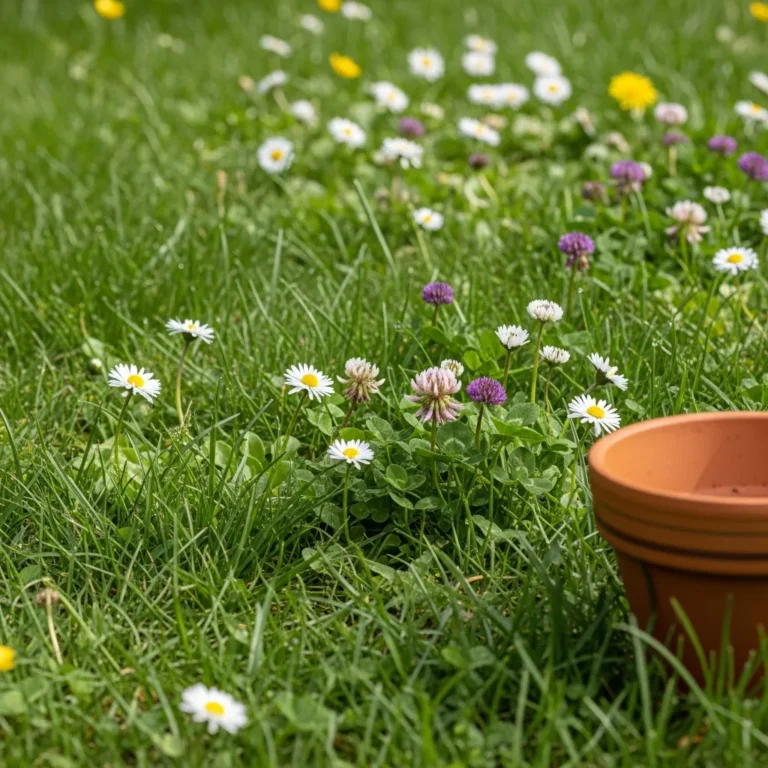
What broadcast treatment costs the rest of the yard
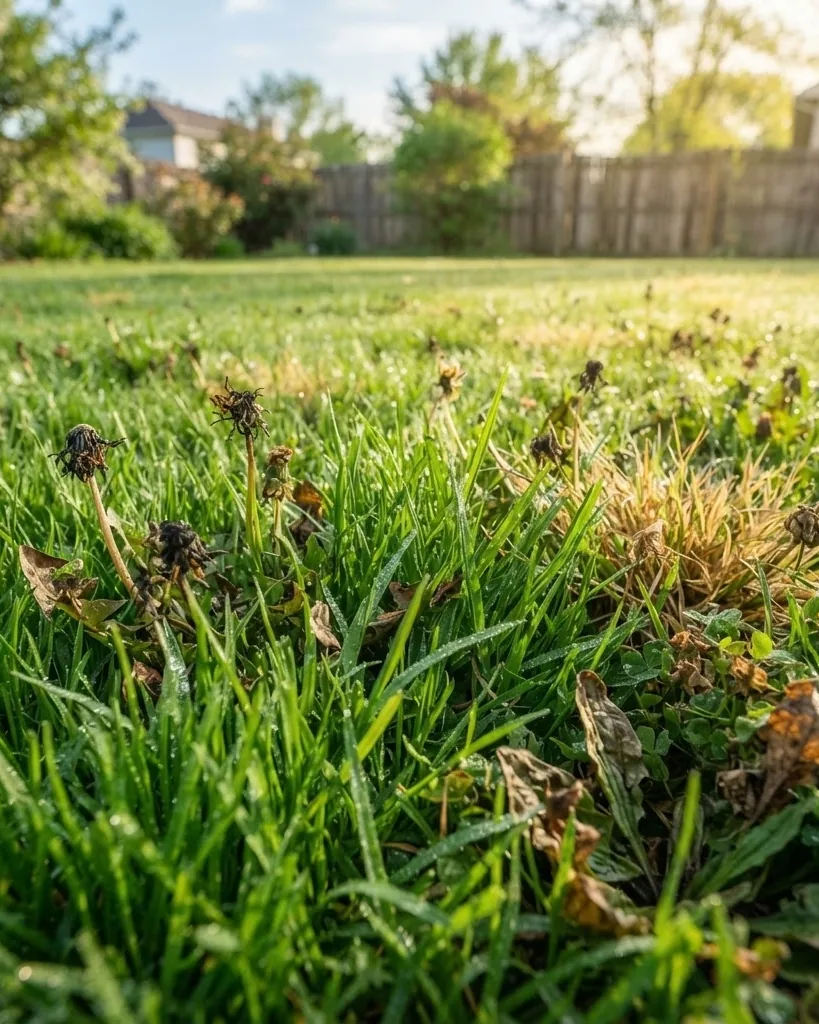
Broadcast application treats 100 percent of the lawn to solve a problem living on a fraction of it. Tree and shrub roots run well past the drip line and absorb these auxins from turf soil, which is why many labels prohibit application over the root zones of desirable woody plants. Cupped, strapped or twisted new growth on redbud, tomato and hydrangea is the classic signature. White clover dies by design in a 2,4-D and mecoprop blend, a feature when clover counted as a weed and an increasing liability for anyone keeping pollinator forage. Runoff toward storm drains is the reason state legislatures wrote the fertilizer laws at all. If your hydrangea leaves cup in June, separate herbicide injury from technique before blaming your cuts, since pruning hydrangeas without removing next season’s buds is a different failure with a different fix.
Troubleshooting: nothing died, or the lawn striped
Most complaints about weed and feed reduce to four failure modes, and each leaves a distinct signature on the turf. A lawn where weeds stand untouched failed at the herbicide step. A lawn with brown bands failed at the spreader. Diagnosing which one happened determines whether you wait or reapply.
Nothing died. Work through this list in order:
- Wrong weed class. Sedges and grassy weeds survive every broadleaf-only blend.
- Dry blades at application, so granules never adhered.
- Rain inside 24 hours, washing product off the foliage.
- Mowed too soon, removing treated leaf tissue before uptake.
- Air temperature outside the 60 to 90 degrees F window, or weeds not actively growing.
The lawn burned or striped. Dark green ribbons beside pale ones mean uneven distribution: overlapping rotary passes, a drop spreader run twice down the same line, or a gate setting above the labeled 3 1/2 rotary and 5 drop positions. Scorch across a whole area points at quick-release nitrogen applied into heat, or an application above the labeled rate.
Ornamentals cupping. Suspect over-throw into beds from a rotary spreader, or root uptake from turf inside the drip line. Growth that emerges after the injury usually returns to normal, so the corrective action is placement next time.
Intervals before you do anything else. Trimec-type granular labels require at least 30 days between broadcast applications, with two applications per year and 8.0 lb of product per 1,000 sq ft as a seasonal maximum. A second pass eleven days after the first is a label violation before it is a lawn problem.
The two-pass protocol that replaces the bag
Splitting the job removes the compromise entirely. Fertilize when the grass wants nitrogen, on the schedule your extension service publishes for your species and region. Treat weeds when the weeds are vulnerable, which for perennials means autumn translocation and for crabgrass means a pre-emergent one to two weeks ahead of that 55 to 60 degrees F soil threshold. Two dates, two products, no shared window to argue over.
Spot-spray the second half. A liquid broadleaf herbicide applied to the weeds you can see uses a fraction of the chemical that covering the entire lawn requires, which was Alberta’s stated rationale for allowing spot products while banning combinations.
Cultural control does more work than most people expect:
- Mow at roughly 3 in so the canopy shades out germinating weed seedlings.
- Return clippings, worth about 1.0 lb N per 1,000 sq ft per year.
- Overseed thin areas, since bare soil is where weeds establish.
- Soil test before adding phosphorus, which several states require anyway.
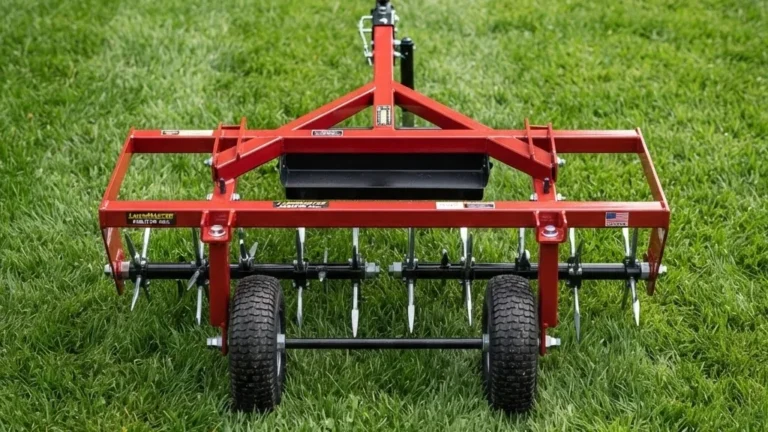
- Relieve compaction, where a tow-behind aerator setup and timing guide covers the equipment side.
Organic options exist with honest limits. Corn gluten meal, iron HEDTA and acetic acid products all appear in this space, and none of them delivers the reliability of a synthetic auxin on established perennial broadleaf weeds. Treat them as part of a program rather than a swap.
When the bag is the right call
Combination products earn their place under a specific set of conditions, and the honest answer is that plenty of lawns meet them. Broadleaf pressure has to be moderate and spread fairly evenly across the turf, because spot-treating forty scattered dandelions beats broadcasting anything. Your grass species has to appear on the tolerant side of the label. The calendar month has to be one where you were already going to fertilize. And the weeds have to be actively growing with daytime temperatures between 60 and 90 degrees F. Meet all four and one pass at 0.80 lb N per 1,000 sq ft does exactly what the package claims.
- Uniform, moderate broadleaf pressure across most of the lawn
- Grass species listed as tolerant on that specific label
- A month already scheduled for feeding
- Active weed growth inside the 60 to 90 degrees F window
Frequently asked questions
Can I use weed and feed on St. Augustine grass?
No. The Scotts Turf Builder Weed and Feed label prohibits application to St. Augustinegrass, including Floratam, along with dichondra, lippia, carpetgrass and bentgrass. Centipedegrass and bahiagrass carry the same warning on most broadleaf blends. Southern lawns need an atrazine-based product labeled for the species, or fertilizer alone plus a spot treatment applied to the weeds themselves.
How long after weed and feed can I water the lawn?
The Scotts label instructs you not to water for 24 hours after application, and not to apply if rain is expected within 24 hours. Granules must stay on weed foliage long enough for uptake. A pre-emergent product asks for the opposite, since it needs irrigation to reach the soil, which is why combination bags force a compromise.
How much nitrogen does a bag of weed and feed apply?
Divide bag weight by coverage in thousands of square feet, then multiply by the nitrogen percentage. A 14.29 lb bag of 28-0-3 covering 5,000 sq ft works out to 2.86 lb of product and 0.80 lb of actual nitrogen per 1,000 sq ft. Purdue University caps any single application at 1.0 lb.
Does weed and feed kill crabgrass?
Only when the label carries a pre-emergent or quinclorac. A broadleaf-only blend of 2,4-D, mecoprop and dicamba does nothing to crabgrass seed or to established plants. University of Illinois Extension places germination above 55 to 60 degrees F soil temperature held seven to ten consecutive days, so pre-emergent timing runs one to two weeks earlier.
Is weed and feed safe for dogs?
Purdue University researchers compared 83 Scottish terriers carrying bladder cancer against 83 controls and found risk 4 to 7 times higher in dogs on herbicide-treated lawns. A Tufts study in Environmental Research linked professionally applied lawn pesticides with 70 percent higher lymphoma risk. Both rest on owner recall, and neither isolates a single active ingredient.
How many times a year can I apply weed and feed?
Two broadcast applications per year is the ceiling on Scotts and on Trimec-type granular labels, with at least 30 days between them and a seasonal maximum of 8.0 lb of product per 1,000 sq ft. Before a second pass, recheck your annual nitrogen budget and consider mulch coverage and weight per cubic yard for bed edges instead.