SAE 30 oil in lawn mower engines runs clean in most four-stroke walk-behinds and riding decks once the air climbs past 40 degrees Fahrenheit, which is about 4 degrees Celsius. That one temperature line settles more arguments than any brand loyalty. The real damage happens when a monograde oil goes, on its own, into a two-stroke trimmer or a bargain push mower that actually wants a gasoline-and-oil premix.
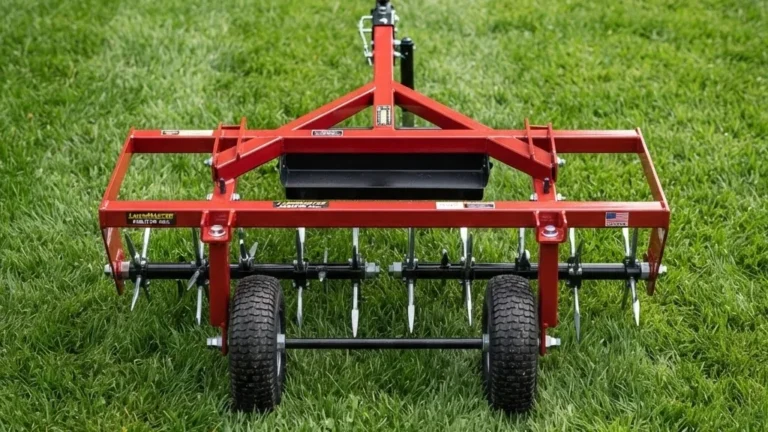
Oil is one line in a long season of yard work that sits next to aeration and feeding, so if the wheels and deck also need spring attention, our pull-behind lawn aerator specs and timing guide covers the rest of the setup.
Quick answer: SAE 30 oil in lawn mower engines is the correct pick for most four-stroke walk-behind and riding mowers in warm weather, meaning air temperatures at or above 40 degrees Fahrenheit, roughly 4 degrees Celsius. It is a monograde grade, so it thickens in the cold and drags on the starter below that line. Do not put it, by itself, into a two-stroke engine, which burns a gasoline-and-oil premix instead of holding oil in a sump.
Check the dipstick or fill cap, read the engine label, and match the service grade the manual asks for. The owner manual always wins the tie. Everything below breaks that answer into the checks you actually run at the workbench: engine type, temperature, service grade, capacity, and what to do with the oil once it comes out.
Two-Stroke or Four-Stroke: The Check That Saves the Engine
Before the oil choice comes the engine type. A four-stroke mower carries a separate oil sump with its own dipstick or marked fill cap, and it takes straight SAE 30 in the crankcase. A two-stroke engine holds no sump at all and burns oil that was blended into the gasoline before the tank was filled.
Drop a monograde like SAE 30 by itself into a two-stroke and it runs dry, overheats, and scores the cylinder wall within minutes of running. Repair Clinic, a widely used parts and repair reference, states the split cleanly: four-stroke units use crankcase oil, while two-stroke units need a fuel blend, often mixed at a ratio of 50 parts gasoline to 1 part oil. Miss this single fact and no chart in the world protects the machine.
Telling the two engines apart takes about ten seconds.
- Find the oil fill. A dipstick or a clearly marked oil cap means four-stroke.
- Read the shroud. A sticker showing 40:1, 50:1, or the words “mix fuel” means two-stroke.
- Count the openings. A two-stroke has one tank for premixed fuel; a four-stroke has one for gasoline and a second for oil.
- Judge by class. Most walk-behind and riding mowers built around Briggs and Stratton, Honda, Kawasaki, or Kohler engines are four-stroke, while many string trimmers and older curbside push mowers are two-stroke.
The mistake usually starts with a good instinct. Someone has a fresh bottle of SAE 30 on the bench and assumes any small engine will drink it. On a four-stroke that assumption is fine. On a two-stroke it strips the only lubrication the piston ever gets, because the oil is supposed to arrive dissolved in the fuel and coat the internals as the mix burns.
Run the check in order. Is there a separate oil fill? If yes, four-stroke, and SAE 30 in the sump is on the table. If no, the engine is two-stroke and needs its premix at the ratio printed on the housing. Only after that answer is settled does temperature or brand enter the conversation.
A quick way to confirm the type without opening a manual: look at the exhaust note and the fuel setup at the pump. A two-stroke buyer is used to mixing a small can of oil into a gas can before every fill, and the container often carries a mixing chart printed right on the label. A four-stroke owner fills gasoline alone at the pump and only ever touches oil at the dipstick. If the household routine already involves premixing fuel in a can, the engine on the bench is almost certainly two-stroke, and SAE 30 has no business going in as a standalone fill.
What SAE 30 Actually Means Under the SAE J300 Standard
SAE 30 is a monograde oil rated by the Society of Automotive Engineers, and its viscosity number is measured at 100 degrees Celsius. The “30” describes how the oil flows when the engine is hot and running. A monograde carries one rating and one behavior, which is why it shines in steady summer heat and struggles the moment the mornings turn cold. The classification system behind that number is SAE J300, the standard that assigns every engine oil its grade.
Multigrade oils read differently. A grade like 10W-30 or 5W-30 carries two numbers split by a “W,” which stands for Winter. The first number rates cold-start flow, the second rates hot-running flow. That is the entire trick: a multigrade behaves like a thin oil on a cold morning and a thicker oil once the engine reaches operating heat. SAE 30 skips the cold half of that range, so it pours slowly when the metal is cold and can leave the starter fighting a stiff crank on a chilly day.
Think of viscosity as resistance to flow, not thickness in a jar at room temperature. Two oils can look identical sitting on a shelf and behave completely differently once they are circulating through hot bearings and a spinning crankshaft. That is why the number on the bottle is tied to a lab test at a fixed temperature rather than a guess based on how the liquid pours out of the bottle in your garage. Trusting the printed grade over a visual check is the whole point of the SAE J300 standard existing in the first place.
SAE 30 Oil in Lawn Mower Engines and the 40 F Cutoff
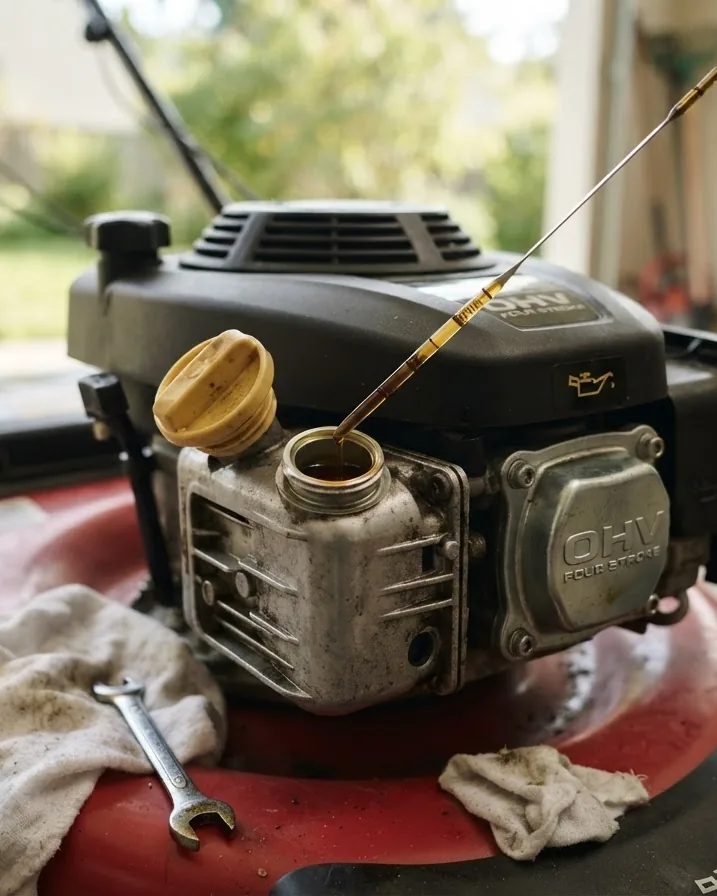
Temperature is the deciding variable once you know the engine is four-stroke. Briggs and Stratton recommends SAE 30 for warm operating conditions at or above 40 degrees Fahrenheit, about 4 degrees Celsius, and warns that below 40 degrees Fahrenheit the same oil causes hard starting. That is the whole rule in one sentence: warm season, SAE 30 is at home; cold season, it thickens and the engine fights back. For anyone mowing outside the United States, the same threshold reads as roughly 4 degrees Celsius, which the North American charts rarely translate for you.
Here is the practical map most manuals fold into a single graphic. You can find the full version inside Briggs and Stratton’s oil type and capacity FAQ, and it lines up like this:
- SAE 30: recommended at or above 40 degrees Fahrenheit, or about 4 degrees Celsius. This is the standard warm-weather grade for most four-stroke mowers.
- 10W-30: covers a wider swing of temperatures, so it starts easier on cold mornings that would choke a monograde.
- 5W-30 synthetic: the cold-climate answer, flowing when the mercury drops well below freezing.
The failure modes are worth naming, because they are what actually reaches the repair bench. Run SAE 30 on a cold morning and the crank turns slowly, the pull cord feels like it caught on something, and the engine coughs before it fires. That is the monograde refusing to flow.
Push the other direction and the trade flips. Briggs and Stratton notes that above 27 degrees Celsius, using 10W-30 can increase oil consumption, which is one reason the straight SAE 30 keeps its place in high summer for air-cooled engines. Air-cooled small engines run hot by design, and a monograde that holds its film at heat can burn off less than a thinner multigrade under the same load. That is the quiet case for keeping a bottle of SAE 30 on the shelf even in the multigrade era.
So the tree has three branches. Cold mornings below 40 degrees Fahrenheit push you toward 10W-30 or a 5W-30 synthetic. Steady heat, especially past 27 degrees Celsius, favors SAE 30. And a synthetic in the correct grade is acceptable across a wider temperature band without changing how often you drain it.
Picture a season that swings from a cold snap in early spring to a heat wave in July. A mower filled with SAE 30 in March might crank slowly on the first mow of the year, especially before the engine has warmed in the sun for an hour. The same bottle of SAE 30, left untouched through summer, protects the same engine perfectly once daytime highs settle above 40 degrees Fahrenheit for good. Owners in climates with a real winter often keep two bottles on the shelf: a multigrade for the shoulder seasons, and SAE 30 once the mowing season is reliably warm.
API Service Grades: Why SF, SG, SH and SJ Still Appear on the Bottle
Viscosity is only half the label. The other half is the service category set by the American Petroleum Institute, printed as codes like API SF, API SG, API SH, or API SJ, and running up through newer marks like API SN and API SP. These letters describe the additive package, the detergency and wear protection, not the thickness. A manual that calls for one of the older grades is telling you the minimum chemistry the engine was designed around, and matching or exceeding it keeps deposits and wear in check.
The rule that saves confusion is backward compatibility. The American Petroleum Institute explains that its newest gasoline category includes the performance of the ones before it, so if your manual asks for API SN, an oil marked API SP delivers full protection. You can confirm the ladder on the American Petroleum Institute’s engine oil category reference, which also ties the whole system back to the SAE J300 viscosity standard.
Read the two halves together and the bottle stops being a puzzle. The number, such as SAE 30, tells you flow. The API code tells you the additive chemistry. A quality SAE 30 that carries a current API service mark satisfies both demands for a warm-weather four-stroke mower, which is exactly what those old SF and SG callouts in decades-old manuals were reaching for.
Older manuals were written when SF or SG was the current grade, and shops sometimes assume that means only an antique-spec oil will do. That is backwards. Because each newer API category is built to exceed the one before it, a bottle marked with a current designation already satisfies the older requirement the manual printed decades ago. The only time this backward compatibility does not apply is with certain diesel-specific categories, which do not concern a gasoline-powered mower engine at all.
Reading Your Owner’s Manual: A Worked Example
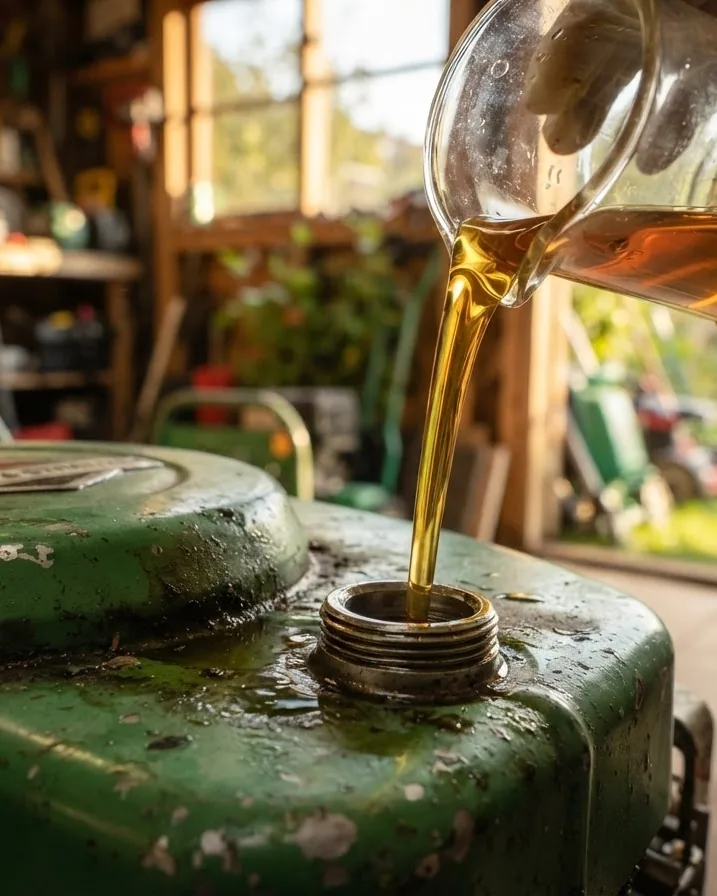
Pull the manual for a mid-size walk-behind mower with a Briggs and Stratton engine and the oil section usually reads something close to this: use SAE 30 above 40 degrees Fahrenheit, use SAE 10W-30 for a broader temperature range, and use synthetic 5W-30 for temperatures below freezing. It then lists the required API service classification, often SF or higher on older units and SG or higher on more recent ones. That single paragraph is the entire decision tree in miniature.
Apply it step by step. First, confirm the engine is four-stroke by locating the dipstick. Second, check the forecast for the week you plan to mow, not just today, since a warm afternoon followed by a cold morning start still counts as cold-weather starting. Third, pick the grade that matches that temperature band from the chart above. Fourth, check the bottle for an API mark that meets or exceeds what the manual specifies. If all four line up, pour to the dipstick mark and stop.
Riding mowers and zero-turn units often carry a slightly different table because their larger engines run at different loads, so never assume the walk-behind chart applies word for word to a riding deck from the same manufacturer. The safest habit is keeping the manual, or a photo of its oil page, saved on a phone so the chart is available standing at the shelf in the store rather than guessing from memory.
How Much Oil Your Mower Holds and When to Drain It
Capacity is where overfilling wrecks a good oil choice. A typical walk-behind mower holds a small sump, and Briggs and Stratton lists common capacities of 15 ounces or 18 ounces, with an oil change every 50 hours of run time or once a year, whichever comes first. Riding mowers carry far more, in the range of 48 ounces to 64 ounces, changed every 100 hours or once a year. Those are small volumes on the walk-behind side, so the margin for pouring too much is thin.
Overfilling is its own failure. Too much oil in a compact crankcase gets whipped by the crankshaft, foams, and can push past seals or into the cylinder, leaving you with smoke, hard starts, and a mess that looks like a bad oil choice but started with a heavy hand at the bottle. Fill to the dipstick mark, wipe, recheck, and stop there.
Two timing details matter beyond the numbers:
- Break-in. A brand-new engine benefits from an early first change, well before the normal interval, to flush out the metal particles that shed as parts seat.
- The calendar limit. Even a mower that logs few hours should be drained once a year, because oil degrades sitting in a warm sump between mowings.
Brand manuals from Briggs and Stratton, Honda, Kawasaki, and Kohler differ on exact numbers, which is why the golden rule stays constant: read the manual for your specific engine before you trust any generic figure. Chemical lawn care follows the same logic, and if you want to see how label instructions hide the real dosing, our breakdown of what a weed and feed bag hides makes the point in a different aisle.
A quick way to check level without a dipstick marking that has worn off: pour a small measured amount at a time, using the ounce figures above as a target, then check for oil pooling around the fill neck rather than trusting a stick that has lost its etching. On riding mowers with a wider sump, checking on level ground matters more than on a walk-behind, since a sloped driveway can show a false low or false full reading on the stick.
Common Symptoms When the Wrong Oil Is Already In the Engine
Sometimes the question comes after the fact, once a mower is already running poorly and the owner suspects the oil in the sump is not the right grade. A few symptoms point clearly at a viscosity mismatch rather than a fuel or spark problem.
- Hard cranking on a cool morning that clears up once the engine has run a few minutes usually points to a monograde like SAE 30 sitting in cold weather.
- Blue-tinged exhaust smoke and a dropping oil level between mowings, especially in hot weather, can point to a multigrade thinning out too much under heat load.
- A knocking or ticking sound right after a cold start, fading as the engine warms, often means the oil is too thick to reach the upper valve train quickly.
- Oil visibly leaking or weeping from the base gasket shortly after a fill usually means overfilling rather than a grade mismatch, and the fix is draining back to the dipstick line rather than switching oil type.
None of these symptoms require guessing. Drain the oil, check the label against the temperature it was filled in, and refill with the grade that matches the current season and the API code the manual specifies. Most of these complaints clear up within one full oil change, since the wrong grade rarely causes lasting damage if it is corrected quickly.
SAE 30 vs 10W-30 in Real Summer Heat
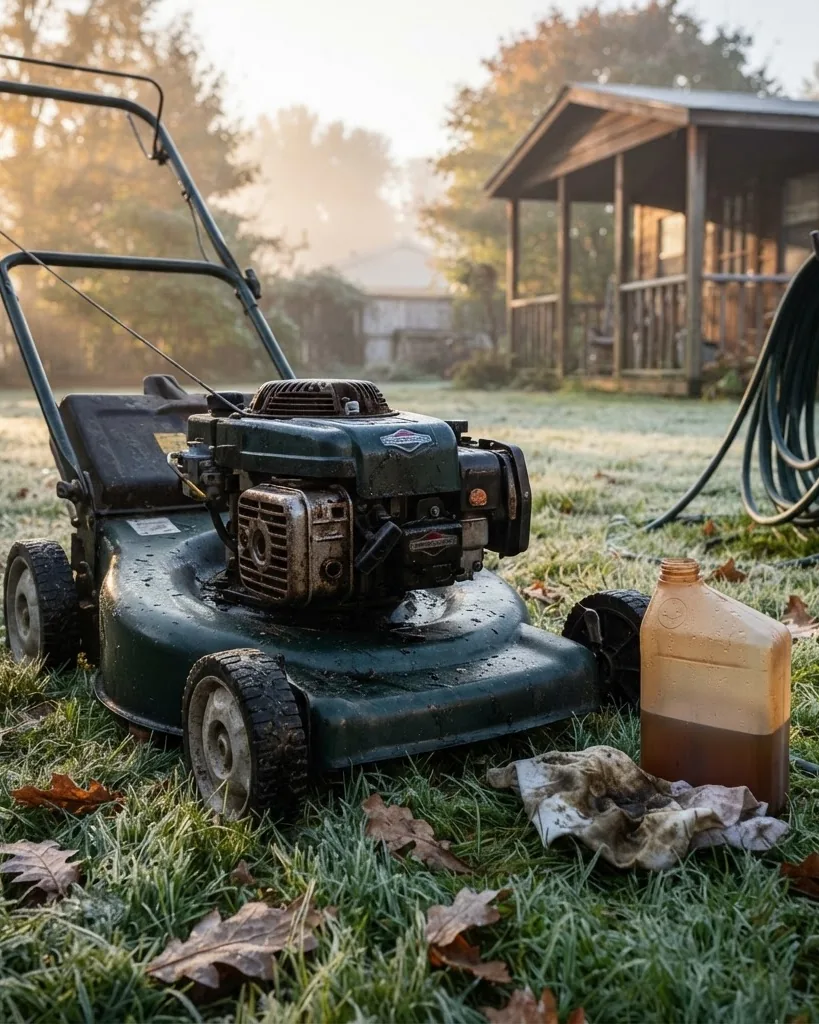
In genuine summer conditions the two grades trade places. A four-stroke air-cooled mower engine runs hot under load, and SAE 30 holds its protective film at those temperatures without the thinning that a lighter cold-start oil shows. Briggs and Stratton points out that above 27 degrees Celsius, 10W-30 can raise oil consumption, meaning the crankcase burns off more between top-ups.
So on a scorching afternoon, straight SAE 30 in a four-stroke often stays cleaner on the dipstick than the multigrade, while 10W-30 keeps its edge on cool mornings and shoulder-season days when the machine has to start cold. Match the oil to the season the mower actually works in, and if the household only wants to keep one bottle on the shelf year-round, a full synthetic multigrade rated for the coldest morning and the hottest afternoon in the local climate is the compromise that avoids swapping oils twice a year.
Edge Cases: Storage, Old Oil, and Mixed Climates
A few situations do not fit neatly into the temperature chart above, and each has a simple answer.
Storing a mower over winter with old oil still in the sump is common but not ideal. Moisture and combustion byproducts accumulate in oil that sits unused for months, so draining before storage and refilling at the start of the next season protects the internals better than leaving old oil in place through the cold months, even if the mower will not run again until spring.
An unopened bottle of SAE 30 does not spoil quickly, but a bottle that has been opened and exposed to air and temperature swings in a garage for several seasons can pick up moisture and lose some of its additive effectiveness. If a bottle has been open for more than a year or shows any cloudiness or separation, it is cheap insurance to buy a fresh one rather than trust it in the crankcase.
Climates that see a real winter and a hot summer in the same year are the reason multigrade oils exist at all. Rather than switching bottles every few weeks as the weather swings, many owners in these regions run a 10W-30 or synthetic blend through the whole season and reserve straight SAE 30 for a stretch of settled, reliably hot weather where the reduced consumption matters, such as a long midsummer run of mowing every few days.

Recycling Used Mower Oil and the Oil Filter
Draining is only half the job; the used oil has to go somewhere legal. The US Environmental Protection Agency treats used oil as a recoverable resource, and the arithmetic is striking. It takes 42 gallons of crude oil, but only 1 gallon of used oil, to produce 2.5 quarts of new, high-quality lubricating oil. That single comparison is the strongest argument for hauling your drained oil to a collection point rather than dumping it. Poured on the ground or down a drain, used mower oil can foul soil and water, which is why disposal belongs in any honest oil guide.
The routine is short and worth doing right every time:
- Catch the drain in a clean container with a sealing lid, not an open bucket that can spill or collect rain.
- Recycle the oil filter too, since it holds trapped oil and metal that also belongs at a recycling site.
- Take both to an auto parts store, service station, or municipal collection center that accepts used oil.
The rules and the reasoning sit on the US Environmental Protection Agency’s page on managing and recycling used oil, and they apply to a one-quart mower drain just as much as to a car. Small volumes add up across a neighborhood of mowers, and most municipal collection points that take automotive oil accept small-engine oil under the same rules without any extra paperwork.
Frequently Asked Questions
Can I use SAE 30 oil in a lawn mower in cold weather?
It is a poor choice below 40 degrees Fahrenheit, about 4 degrees Celsius. Briggs and Stratton warns that SAE 30 causes hard starting under that line because the monograde thickens and resists flow. For cold mornings, switch to 10W-30, or a 5W-30 synthetic for deep cold, then return to SAE 30 for the warm mowing season.
Is car oil the same as SAE 30 mower oil?
A quality SAE 30 rated with a current American Petroleum Institute service grade can serve a warm-weather four-stroke mower, since the standards are shared. The catch is the grade and the manual. Match both the viscosity and the API code your engine specifies, and never route any four-stroke oil into a two-stroke that needs premixed fuel instead.
What happens if I overfill the crankcase?
Too much oil in a small sump gets churned by the crankshaft, foams, and can pass seals or reach the cylinder. The result is smoke, hard starting, and possible seal damage that mimics a bad oil choice. With walk-behind capacities near 15 to 18 ounces, the margin is small, so fill to the mark, recheck, and stop.
SAE 30 or 10W-30 for hot summer mowing?
In steady heat, SAE 30 usually holds up better in a four-stroke air-cooled engine. Briggs and Stratton notes that above 27 degrees Celsius, 10W-30 can increase oil consumption. So a monograde often stays cleaner on the dipstick in high summer, while 10W-30 keeps its advantage on cooler mornings and cold starts.
Does synthetic oil change how often I drain it?
Not on its own. A synthetic in the correct grade is acceptable across a wider temperature range, but that flexibility does not stretch the drain interval. Keep the same schedule the manual gives, which for many walk-behind mowers is every 50 hours or once a year, and for riding mowers roughly every 100 hours or annually.
Where do I recycle used mower oil?
Take it to an auto parts store, service station, or local collection center that accepts used oil, and bring the filter as well. The US Environmental Protection Agency frames this as recovery, noting that only 1 gallon of used oil can be re-refined into 2.5 quarts of new lubricating oil. Never pour it on soil or into drains.
The Bottom Line
Two questions decide almost everything. Is the engine four-stroke, with its own oil sump? Is the air at or above 40 degrees Fahrenheit, about 4 degrees Celsius? If both answers are yes, a quality SAE 30 carrying a current American Petroleum Institute grade is a sound pick, filled to the mark and never over. If the engine is two-stroke, it wants premixed fuel near 50 to 1, not straight oil.
When the mornings turn cold, move to 10W-30 or a 5W-30 synthetic. Drain on schedule, recycle the oil and the filter, and let the manual settle any tie. Get those calls right and the mower outlasts the debate.