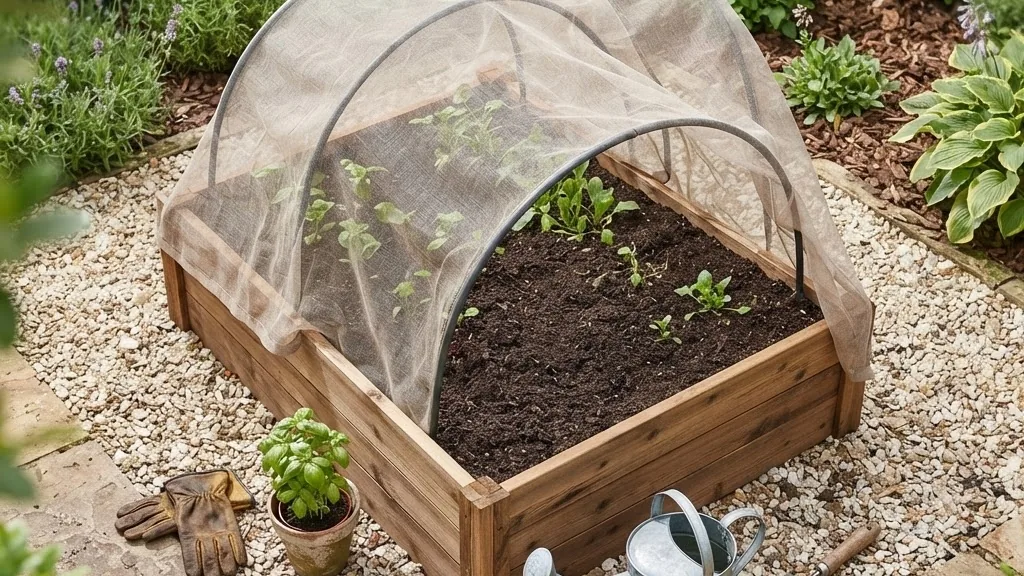
Cover a raised garden bed and you change what it can do, because a single 4-foot frame stops being a fair-weather planter and turns into a season-stretching, pest-proof, heat-buffered growing box. The trouble is that “covering” means four different jobs, and the wrong cover for the wrong job wastes money and sometimes kills the very plants you meant to save. A frost blanket smothers August lettuce. An insect mesh does nothing against a chewing rabbit. This guide sorts the four objectives, gives you the sourced numbers to choose by, and walks the DIY build for a standard bed.
Quick answer: To cover a raised garden bed, first name the problem. For frost, use a floating row cover on hoops and expect roughly 2 F of protection from a light weight up to 6 to 10 F from a heavy one, per University of New Hampshire Cooperative Extension. For chewing insects use 40 to 50 mesh netting. For birds and rabbits use rigid wire mesh. For summer heat use 30 to 60 percent shade cloth. Hoop it, leave a gap above the foliage, weight the edges, and vent on warm days.
Why cover a raised garden bed at all: four jobs, not one
A cover earns its keep by doing one of four distinct jobs, and confusing them is the most common mistake home growers make. The first job is frost protection and season extension, buying weeks in spring and fall. The second is excluding chewing and sucking insects like cabbage white caterpillars, flea beetles and root flies. The third is keeping out birds and small mammals, from finches to rabbits and deer. The fourth, which surprises people, is throwing shade to keep cool-season crops from bolting in July. Each job wants a different material, a different weave and a different install.
- Frost: a breathable spun-bonded blanket that traps radiant heat overnight.
- Insects: a fine mesh sized to the pest, not a blanket.
- Birds and animals: a rigid or taut physical barrier they cannot push through.
- Heat: a knitted shade cloth rated by percentage of light blocked.
Get the pairing right and the frame does the work. Get it wrong and you cook lettuce under frost fabric or let flea beetles waltz through a bird net. Before you buy anything, decide which of the four you are solving this month, because the same bed will need different covers across a single year. Good soil underneath matters as much as the cover above it, which is why the compost ratio and volume guide for raised beds is worth reading alongside this one.
Frost protection: match voile weight to degrees, not vibes
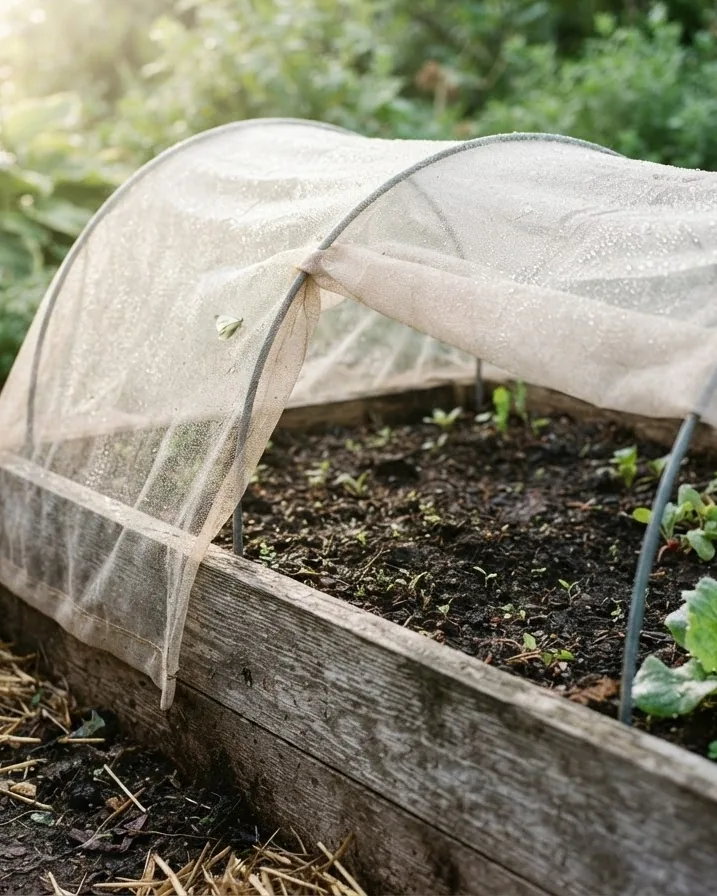
Frost fabric is rated by weight, and weight predicts both warmth and shade, so you cannot cheat one without paying the other. University of New Hampshire Cooperative Extension puts hard numbers on it: a lightweight row cover gives roughly 2 F of frost protection, while a heavy-weight cover can deliver 6 F to 10 F. That range is the difference between shrugging off a light touch of frost and holding tender seedlings through a real hard freeze. The catch is light. A thin voile transmits about 70 percent of daylight and protects down to about 28 F, while a thick one passes only about 30 percent and holds to about 24 F.
Grammage tells the same story in numbers. UNH Extension and Bonnie Plants describe light fabric at roughly 0.45 to 0.5 ounces per square yard and heavy fabric at 1.5 to 2.2 ounces per square yard.
A medium weight, favored by many gardeners, sits near 0.50 to 0.55 ounces, passes about 85 percent of light and still protects to about 28 F. That balance matters because a medium cover can bring crops to harvest up to about 10 days earlier without starving them of sun.
- Light voile: about 2 F, roughly 70 percent light, good to about 28 F.
- Medium voile: to about 28 F, about 85 percent light, up to 10 days earlier.
- Heavy voile: 6 to 10 F, roughly 30 percent light, good to about 24 F.
Standard fabrics you will see on the shelf carry names like Reemay, which is spun-bonded polyester, along with Agribon, Agronet and Typar. Treat those as material labels, not as the source of the degree ratings. One rule outranks the rest: never let wet fabric rest on the leaves. Any foliage pressed against a frozen cover freezes with it, which is exactly why the fabric belongs on hoops with air between cloth and canopy.
Insect exclusion: read the mesh number before you buy
Insect netting is rated in mesh, the count of openings per linear inch, and the higher the number the smaller the bug it stops. Bootstrap Farmer, Shade Cloth Store and Greenhouse Megastore describe 40 to 50 mesh as the common range for vegetable growing. A 50 mesh net excludes insects down to about 0.25 mm, fine enough to block aphids and thrips. A coarser 25 mesh, with holes around 0.72 by 0.97 mm, still stops fruit flies and birds. Choose the number by naming the pest first, then buy the smallest hole that solves it, because finer mesh also cuts airflow.
Netting has a shelf life worth planning around. UV-stabilized insect netting lasts roughly 3 seasons before the fibers degrade, so factor that into cost per year rather than the sticker price. Order generously, too. Growers recommend buying about 10 feet more than the bed length so the fabric can shrink, sag and still close over both ends.
The science behind fine-mesh exclusion is not folklore. Southern SARE, the Sustainable Agriculture Research and Education program under the United States Department of Agriculture, funded project FS13-275, a High Tunnel Pest Exclusion System developed to replace repeated spraying with a physical mesh barrier. The lesson scales down cleanly to a raised bed: a well-sealed mesh keeps the pest out so you never have to knock it back.
- Aphids and thrips: 50 mesh, blocking down to about 0.25 mm.
- Cabbage whites and flea beetles: 40 to 50 mesh.
- Fruit flies and birds: 25 mesh, holes about 0.72 by 0.97 mm.
One warning that saves harvests: pull the mesh off during flowering on any crop that needs pollinators. Zucchini, squash and cucumbers will not set fruit under a sealed net, and gardeners lose entire beds every year to a cover they simply forgot to lift. If crabgrass is your parallel headache along the bed edges, learning how to identify crabgrass in your beds keeps that weed from muscling in while your attention is on the cover.
Birds and animals: a barrier they cannot push through
Birds and mammals need a physical barrier, not a fabric, because a determined rabbit or deer treats floating row cover as a napkin. For pecking birds and light browsers, a taut net over hoops works if the edges are sealed to the frame so nothing slips underneath. For rabbits, groundhogs and deer, you want rigid wire panels or tall netting anchored hard to the bed. The rule is tension and closure: any sag or gap becomes a door, and animals find doors faster than you think.
The raised bed offers one defense a ground plot cannot, and it lives underneath. Burrowing pests, cutworms, wireworms and rodents can climb up through open bottoms and eat roots from below. Anleolife and other builders recommend stapling a sheet of galvanized steel hardware cloth in a quarter-inch, that is 6 mm, mesh across the base of the bed at the moment you assemble it. Do it during construction, because retrofitting a bottom barrier under a full bed of soil is miserable work.
- Top barrier: taut netting or wire on hoops, edges sealed to the frame.
- Bottom barrier: galvanized quarter-inch (6 mm) hardware cloth, installed at build.
- Anchor points: weight or clip every edge so nothing lifts or burrows in.
If you keep hens and cycle their bedding into the garden, the same rodent logic applies to the pile, and the complete guide to a compost bin for chicken manure covers keeping that resource clean and pest-free before it ever reaches the bed.
Summer heat: shade cloth by percentage and crop
Shade cloth is the cover most home growers skip and the one that saves the summer garden, because heat, not cold, is what bolts lettuce and scalds fruit in July. It is rated by the percentage of light it blocks, and the right percentage depends entirely on the crop. Research from the University of Georgia, reported through Sustainable Market Farming, found that 30 percent shade doubled marketable pepper yield, a full 100 percent increase, by improving photosynthesis and cutting heat stress. That is one of the largest single-input gains available to a home grower.
Cool-season leaf crops want more shade than fruiting crops. For summer lettuce, growers use 45 to 60 percent shade cloth on hoops spaced about 6 to 8 feet, roughly 1.8 to 2.4 m, apart. Peppers and tomatoes take the lighter 30 percent so they still ripen. Match the number to what you are trying to protect and resist going darker than the crop needs, because every extra percent of shade is a percent of growth you gave away.
- Peppers and tomatoes: 30 percent shade, protecting yield without stalling ripening.
- Summer lettuce and greens: 45 to 60 percent shade on hoops 6 to 8 feet apart.
Placement of the bed itself decides how much heat you fight in the first place. Cornell University’s Fruition guide advises siting a raised bed where it gets at least 6 to 8 hours of full sun and orienting the long axis east to west on the south side of a building. Get the site right and shade cloth becomes a fine-tuning tool rather than emergency triage. Keep an eye on watering under any summer cover, since trapped air heats fast and dries soil faster than open beds.
The DIY hoop tunnel: dimensions, spacing and cost for a 4-foot bed
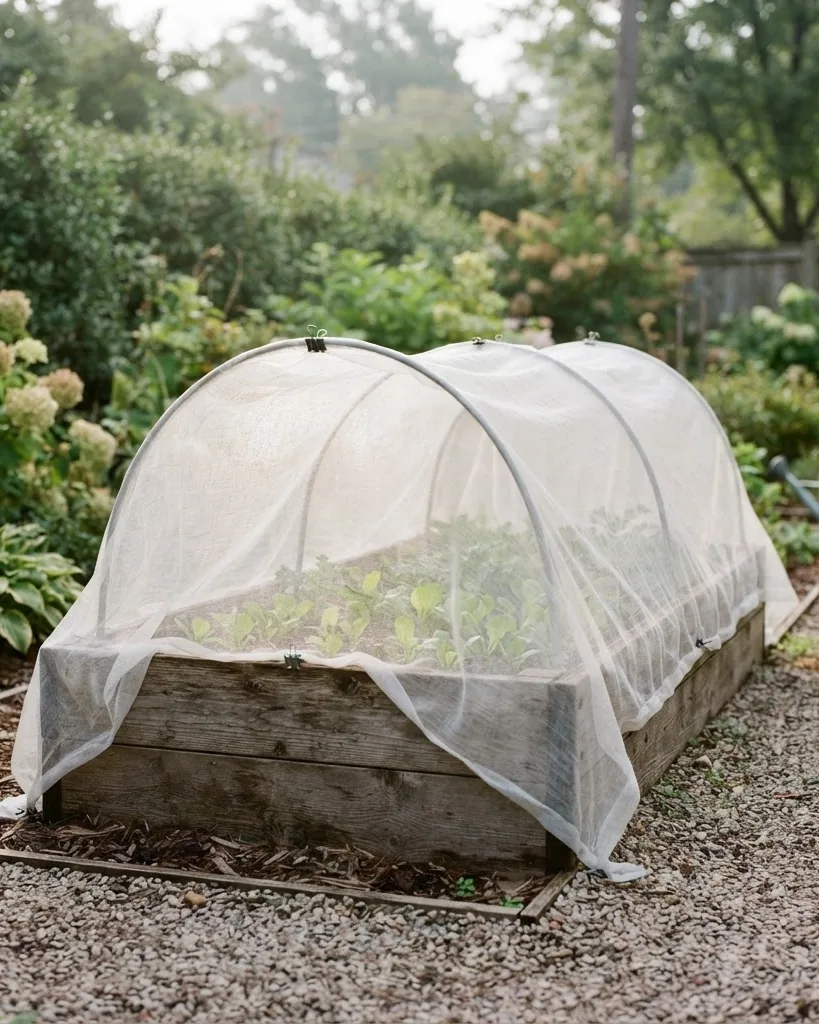
A hoop tunnel is the single most versatile cover system for a raised bed, because the same arches carry frost fabric, insect mesh or shade cloth depending on the season. The Garden Glove’s PEX tunnel design is the reference build for a standard 4-foot, roughly 1.2 m, wide bed. Space one PEX hoop every 4 feet, about 1.2 m, along the length. Cut the hoops around 7 feet, roughly 2.1 m, long, which arches to a tunnel about 2 feet, roughly 0.6 m, tall over a 4-foot bed, enough headroom to keep fabric off the tallest seedlings.
Bend PEX, PVC or fiberglass rods into the arches. PEX is forgiving to bend and cheap; fiberglass resists sun better over years.
Slide the hoops over stakes or into brackets screwed to the inside of the frame, then run the cover across and clamp it with snap clips sized to the tubing. Leave 3 to 6 inches, that is 8 to 15 cm, of slack at each end for the clamps and for closing the tunnel ends. Fabric that stops short of the ends lets pests and cold air pour straight in.
- Hoop spacing: one hoop every 4 feet (1.2 m) of bed length.
- Hoop length: about 7 feet (2.1 m) for a tunnel about 2 feet (0.6 m) tall.
- End allowance: 3 to 6 inches (8 to 15 cm) of slack per end.
- Cover width: standard row cover comes in about 83 inches (2.1 m) or 10 feet (3 m).
Fixing the cover against wind is where builds fail. Weight the edges with bricks, pin them with landscape staples, or trap the fabric under a batten screwed to the frame. Never rely on tucking alone, because one gust turns an unpinned cover into a kite and shreds it on the hoops. Standard row cover widths of about 83 inches, 2.1 m, or 10 feet, 3 m, let you drape a 4-foot bed with plenty to bury on both sides. For extreme cold snaps, individual “Wall of Water” cylinders, about 18 inches, 46 cm, in diameter, insulate single plants to roughly 16 F by releasing stored heat overnight.
Permits, food safety and the authorities that set the rules
Home covers rarely trigger permits, but the moment a raised bed grows into a covered structure or feeds a market stand, several agencies start to matter, and knowing which governs what saves real money. Structure size is the first trip wire. A low hoop tunnel is garden equipment, but a walk-in high tunnel can cross local building thresholds and require a permit, so a five-minute call to your municipal office beats a stop-work order. The line is set locally, which is why a covered bed in one town is exempt and a fined structure in the next.
Here is who governs what, and what each one shapes in practice:
- University Extension services such as University of New Hampshire Cooperative Extension, University of Georgia Extension and Cornell Cooperative Extension issue the science home growers rely on, from the 2 F to 10 F frost figures to the 30 percent shade pepper result. Their advice is free and localized to your region.
- The Natural Resources Conservation Service (NRCS), part of the United States Department of Agriculture, runs cost-share programs such as the Environmental Quality Incentives Program that can offset seasonal high tunnels for qualifying growers, turning a large structure cost into a partial reimbursement.
- The United States Department of Agriculture (USDA) publishes the Plant Hardiness Zone Map and average last-frost dates that set your covering calendar. Cover before your zone’s frost window, not by guesswork.
- The Environmental Protection Agency (EPA) governs pesticide use, which is precisely the input a pest-exclusion cover lets you cut. A sealed 50 mesh net can replace sprays that would otherwise fall under EPA labeling rules.
Food safety enters once produce leaves your own kitchen. Any grower selling covered-bed vegetables should treat this as a You Money or Your Life question, the same standard search engines apply to health and finance content, and follow Extension food-safety guidance on wash water and handling. For chemical inputs, the National Pesticide Information Center, a cooperative between Oregon State University and the EPA, answers questions by phone. The through-line is simple: covers reduce the need for regulated inputs, which is a compliance win as much as a horticultural one.
You can anchor your own schedule to the USDA hardiness data at the USDA Plant Hardiness Zone Map, cross-check the frost degrees at UNH Extension’s row cover guide, and read the mesh-exclusion research on Southern SARE’s High Tunnel Pest Exclusion System page.
Seasonal calendar: which cover goes on when
Covers rotate through the year, and matching the cover to the month is what separates a productive bed from a struggling one. Spring opens with frost fabric on hoops to push transplants out weeks early, using the medium voile that can bring harvest up to about 10 days sooner. As days warm and pests wake, the frost blanket comes off and the 40 to 50 mesh insect net goes on. High summer calls for 30 to 60 percent shade cloth over heat-stressed greens. Fall brings the frost fabric back for a second season-extension run before hard freezes end the year.
- Early spring: medium frost voile on hoops for season extension.
- Late spring into summer: 40 to 50 mesh insect net, lifted at flowering.
- High summer: 30 percent shade for fruiting crops, 45 to 60 percent for greens.
- Fall: frost voile returns, heavier weight as nights drop toward 24 F.
Store covers well and they last their full life; leave them balled up wet and UV-damaged and you buy new ones yearly. Clean fabric, dry it fully, and keep it out of direct sun between uses, since UV degradation is what limits netting to roughly 3 seasons. Fold rather than cram, and label each cover by weight or mesh so next spring you grab the right one without unrolling three. Good habits here quietly cut the running cost of a covered bed to almost nothing.
Ventilation, watering and the mistakes that kill plants
Most cover failures are not equipment failures, they are attention failures, and three mistakes account for the majority of lost crops. The first is foliage touching the cover on a frost night, which freezes the leaves against the fabric no matter how warm the tunnel; keep air between canopy and cloth. The second is heat buildup under a closed cover on a sunny day, which cooks plants even in cool weather because trapped air heats far above outside temperatures. The third is leaving insect mesh on through flowering, which starves pollinator-dependent crops of any fruit set.
Ventilation is the fix for the first two. Open or lift covers on warm, sunny days and reseal at dusk, or the same tunnel that saved plants overnight will scorch them by noon.
Watering needs a plan too, because a sealed cover blocks rain. Run drip irrigation or soaker line under the tunnel so you water without unclamping the whole cover every time.
- Freeze burn: leaves pressed to cold fabric freeze; hoop the cover off the canopy.
- Overheating: vent on sunny days; trapped air outruns the outside temperature fast.
- Failed fruit set: lift insect mesh during flowering on pollinated crops.
Think of the cover as a tool you manage daily, not a lid you set and forget. Match the material to the job, keep it off the leaves, vent it when the sun is out, water underneath, and lift it for the bees. Do those five things and a covered bed outproduces an open one across every season, from the first 28 F night of spring to the 100-degree afternoons that would otherwise bolt your lettuce by breakfast.
Frequently asked questions
What is the cheapest way to cover a raised garden bed?
The cheapest durable system is a PEX or PVC hoop tunnel you bend yourself, one hoop every 4 feet, with a single length of row cover clamped over it. The fabric doubles as frost, insect or shade cover depending on the season, so one frame and two or three cloths handle the whole year cheaply.
How much frost protection does a row cover actually give?
According to University of New Hampshire Cooperative Extension, a lightweight row cover provides about 2 F of frost protection, while a heavy-weight cover delivers 6 F to 10 F. A thin voile holds to about 28 F and a thick one to about 24 F. Keep the fabric off the foliage or leaves freeze against it regardless.
What mesh size keeps insects out of a raised bed?
Use 40 to 50 mesh netting for most vegetable pests. A 50 mesh excludes insects down to about 0.25 mm, including aphids and thrips, while a coarser 25 mesh with holes around 0.72 by 0.97 mm still stops fruit flies and birds. UV-stabilized netting lasts roughly 3 seasons before it degrades.
Does shade cloth really increase yields?
Yes, on heat-stressed crops. University of Georgia research reported through Sustainable Market Farming found 30 percent shade doubled marketable pepper yield, a 100 percent increase, by improving photosynthesis. Summer lettuce wants heavier cover, 45 to 60 percent shade, on hoops spaced 6 to 8 feet apart to prevent bolting in the heat.
Should I put a barrier under a raised bed too?
If burrowing pests are a problem, yes. Staple galvanized steel hardware cloth in a quarter-inch, 6 mm, mesh across the bottom of the bed during construction. It blocks cutworms, wireworms and rodents from eating roots from below. Retrofitting a full, soil-filled bed is far harder, so install the barrier at build time.
How long should I buy the cover compared to the bed?
Buy generously. Order about 10 feet more than the bed length so the cover can shrink, sag and still close over both ends. Standard row cover widths run about 83 inches or 10 feet, and leaving 3 to 6 inches of slack per end gives room for clamps and a proper seal against pests and cold.